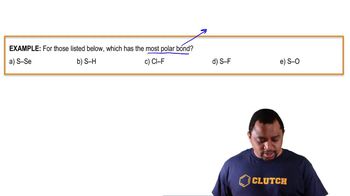
For each compound, determine the direction of bond polarity.
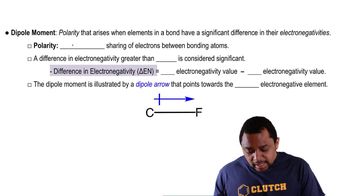
For each polar bond, the dipole arrow points toward the more electronegative atom, showing the direction of bond polarity.
Identify the overall molecular dipole moment of acetone using a vector arrow.
The overall molecular dipole moment of acetone points from the methyl groups toward the oxygen atom, the most electronegative atom.
For each bond, show the direction of polarity by selecting the correct partial charges.
Assign δ- to the more electronegative atom and δ+ to the less electronegative atom for each bond.
The permanent electric dipole moment of the water molecule (H2O) is 6.2×10⁻³⁰ C·m. What does this value represent?
This value quantifies the strength of the separation of positive and negative charges in the water molecule, indicating its polarity.
Which element on the periodic table has the highest electronegativity and why is this important for dipole moments?
Fluorine has the highest electronegativity, making it the most likely to attract electrons and create strong dipole moments in bonds.
How does the difference in electronegativity between two atoms affect the type of chemical bond formed?
A small difference (0–0.4) results in a nonpolar covalent bond, a moderate difference (0.5–1.7) leads to a polar covalent bond, and a large difference (>1.7) produces an ionic bond.
What is the significance of the direction of the dipole arrow in a polar bond?
The dipole arrow points toward the more electronegative atom, indicating the direction in which electrons are more strongly attracted.
Why do ionic bonds have full charges while polar covalent bonds have partial charges?
In ionic bonds, electrons are fully transferred from one atom to another, creating full positive and negative charges, while in polar covalent bonds, electrons are shared unequally, resulting in only partial charges.
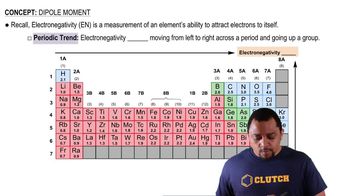
How does the periodic trend of electronegativity help predict bond polarity?
Electronegativity increases across a period and up a group, so atoms on the right and top of the periodic table are more likely to form polar bonds with atoms from the left or bottom.
What happens to the electron cloud in a nonpolar covalent bond compared to a polar covalent bond?
In a nonpolar covalent bond, the electron cloud is evenly distributed between the atoms, while in a polar covalent bond, it is shifted toward the more electronegative atom.