Back

Electrolytes quiz

Control buttons has been changed to "navigation" mode.
1/15
  • What is an electrolyte?

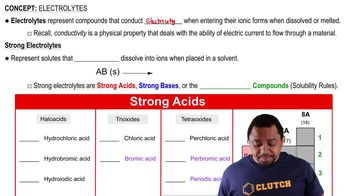
    An electrolyte is a substance that conducts electricity by forming ions in solution or when melted.
  • What distinguishes a strong electrolyte from a weak electrolyte?

    A strong electrolyte completely dissociates into ions in solution, while a weak electrolyte only partially ionizes.
  • Name three types of strong electrolytes.

    Strong acids, strong bases, and soluble ionic compounds are all strong electrolytes.
  • List the strong acids you need to remember.

    The strong acids are hydrochloric acid, hydrobromic acid, hydroiodic acid, chloric acid, bromic acid, nitric acid, perchloric acid, perbromic acid, periodic acid, and sulfuric acid.
  • Which groups of metals form strong bases when combined with certain anions?

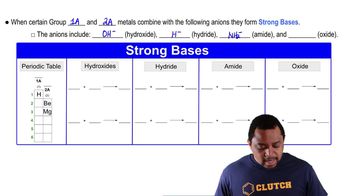
    Group 1A and 2A metals form strong bases when combined with hydroxide, hydride, amide, or oxide ions.
  • Give an example of a strong base formed from a Group 1A metal.

    Lithium hydroxide (LiOH) is a strong base formed from lithium, a Group 1A metal.
  • What is the difference in ionization between strong and weak electrolytes?

    Strong electrolytes ionize completely in solution, while weak electrolytes only partially ionize.
  • What are weak electrolytes typically classified as?

    Weak electrolytes are typically weak acids or weak bases.
  • If an acid is not one of the strong acids listed, what is it classified as?

    It is classified as a weak acid and therefore a weak electrolyte.
  • Name two examples of weak bases.

    Beryllium hydroxide and ammonium hydroxide are examples of weak bases.
  • What is an amine, and give an example.

    An amine is a compound containing nitrogen and hydrogen, such as ammonia (NH3) or methylamine (CH3NH2).
  • What are non-electrolytes?

    Non-electrolytes are substances that do not ionize at all in solution and therefore do not conduct electricity.
  • Give three examples of non-electrolytes.

    Water, sugars (like glucose and sucrose), and alcohols (like methanol and phenol) are non-electrolytes.
  • What is the general formula for sugars, and name two common examples.

    Sugars generally have the formula Cn(H2O)n; common examples are glucose (C6H12O6) and sucrose (C12H22O11).
  • How do the solubility rules relate to electrolytes?

    The solubility rules help determine if a compound will dissolve and ionize, which indicates its strength as an electrolyte.