Skip to main content
General Chemistry
My Course
Learn
Exam Prep
AI Tutor
Study Guides
Textbook Solutions
Flashcards
Explore
My Course
Learn
Exam Prep
AI Tutor
Study Guides
Textbook Solutions
Flashcards
Explore
Back
Experimental Error quiz
You can tap to flip the card.
Define:
What is the difference between accuracy and precision in scientific measurements?
You can tap to
flip the card.
👆
What is the difference between accuracy and precision in scientific measurements?
Accuracy is how close a measurement is to the true or accepted value, while precision is how close repeated measurements are to each other.
Track progress
Control buttons has been changed to "navigation" mode.
1/15
Related flashcards
Related practice
Recommended videos
Experimental Error definitions
Experimental Error
10 Terms
Experimental Error quiz
Experimental Error
21 Terms
Experimental Error quiz #1
Experimental Error
10 Terms
Experimental Error
4. BONUS: Lab Techniques and Procedures
10 problems
Topic
Distillation & Floatation
4. BONUS: Lab Techniques and Procedures
10 problems
Topic
4. BONUS: Lab Techniques and Procedures
7 topics
15 problems
Chapter
Guided course
05:50
Experimental Error
Jules Bruno
3386
views
8
rank
1
comments
Guided course
02:53
Random Errors
Jules Bruno
3165
views
3
rank
Guided course
03:53
Systematic Error
Jules Bruno
3595
views
6
rank
Terms in this set (15)
Hide definitions
What is the difference between accuracy and precision in scientific measurements?
Accuracy is how close a measurement is to the true or accepted value, while precision is how close repeated measurements are to each other.
How can random errors in an experiment be minimized?
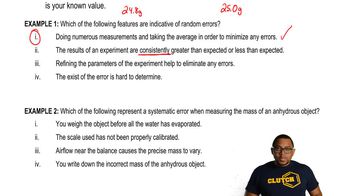
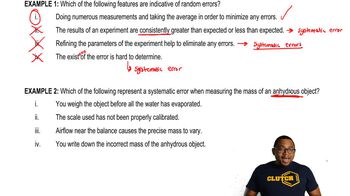
Random errors can be minimized by taking multiple measurements and averaging the results.
What characterizes a systematic error in an experiment?
Systematic errors produce consistently biased results that are always too high or too low and are often due to flaws in the experimental setup.
Why are systematic errors harder to detect than random errors?
Systematic errors are harder to detect because they consistently give the same incorrect result, making it seem like the measurements are accurate.
What is the formula for percent error?
Percent error is calculated as the absolute value of (experimental value - theoretical value) divided by the theoretical value, multiplied by 100.
What is typically considered an acceptable percent error in most experiments?
A percent error less than 10% is typically considered acceptable.
What does a large percent error indicate about your measurements?
A large percent error indicates that your measurements are not very precise.
What is the best way to minimize random error in a measurement?
The best way is to take several measurements and calculate their average.
If an experimental result is always higher or always lower than the true value, what type of error is likely present?
This is likely a systematic error.
How can systematic errors be corrected in an experiment?
Systematic errors can often be corrected by adjusting or refining the experimental setup.
What is an example of a systematic error when measuring the mass of an anhydrous object?
Weighing the object before all water has evaporated, resulting in a mass that is always too high, is a systematic error.
Why is calibrating a scale important in minimizing systematic error?
Calibrating a scale ensures that measurements are as close as possible to the true value, reducing systematic error.
What type of error is caused by unpredictable fluctuations, such as airflow near a balance?
This is an example of a random error.
If you write down the incorrect mass during an experiment, what type of error could this be?
This could be a systematic error if it is due to a flaw in the experimental procedure, but it could also be random if it happens by chance.
What is the theoretical value in the context of percent error calculations?
The theoretical value is the accepted or literature value that your experimental results are compared to.
 BackBack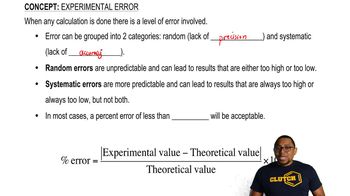
 05:50
05:50