Extraction quiz #1 Flashcards

Extraction quiz #1
Control buttons has been changed to "navigation" mode.
1/10
  • What is extraction in chemistry?
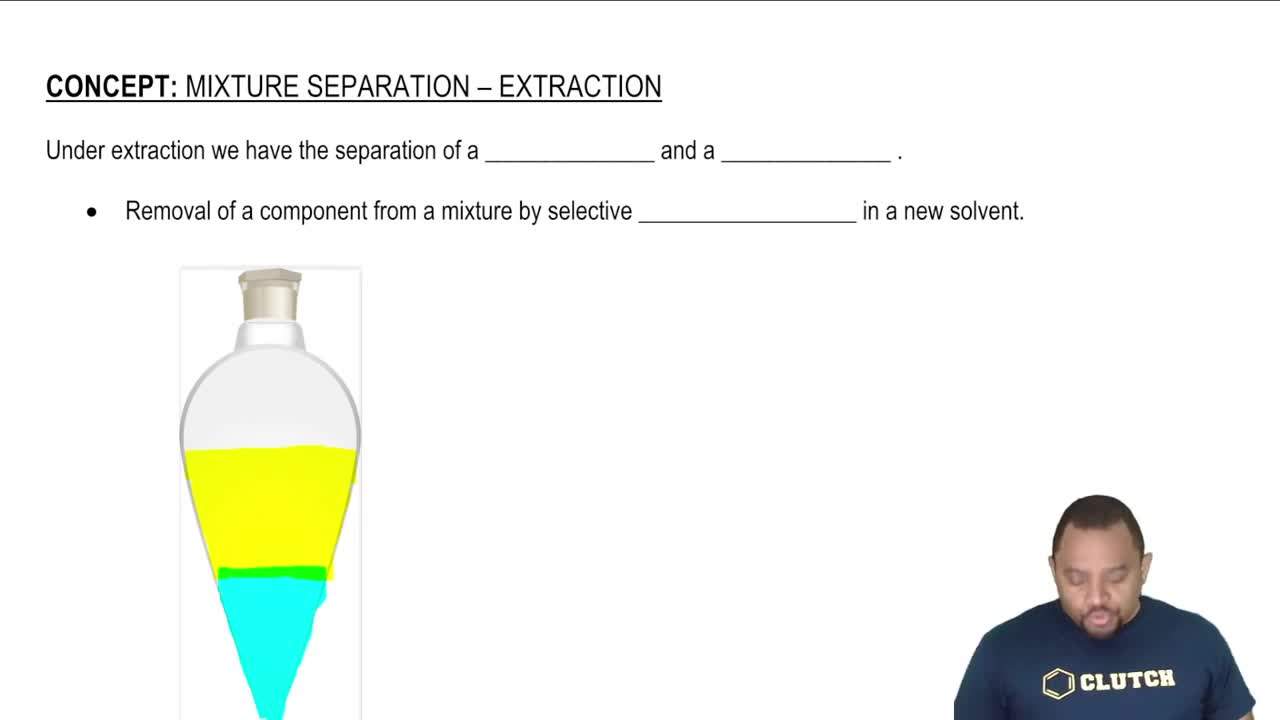
    Extraction is a laboratory technique used to separate components from a mixture by exploiting their differences in solubility in various solvents, often using acid-base reactions to selectively alter the solubility and isolate specific compounds.
  • What is the purpose of using a separatory funnel in extraction?
    A separatory funnel allows for the mixing and separation of immiscible liquids, typically an organic and an aqueous layer, to isolate specific compounds based on their solubility.
  • Why does the formation of an ion increase a compound's solubility in the aqueous layer during extraction?
    Ions are polar and therefore dissolve more readily in the polar aqueous layer, allowing charged compounds to move from the organic to the aqueous phase.
  • How can you confirm that all acetic acid has been removed from the organic layer during extraction?
    You can use pH strips to check that the organic layer is completely basic, indicating that all acetic acid has reacted and been removed.
  • Why is it recommended to use a weak base before a strong base in acid-base extraction?
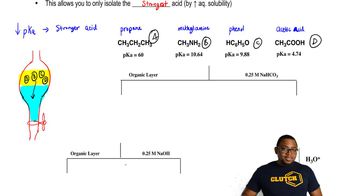
    Using a weak base first selectively reacts with the strongest acid, allowing for stepwise separation of acids with different strengths.
  • What does a lower pKa value indicate about a compound in the context of extraction?
    A lower pKa value means the compound is a stronger acid and will react more readily with bases during extraction.
  • What safety precaution should be taken when mixing acids and bases in a separatory funnel?
    You should periodically release built-up pressure by opening the funnel to allow gases to escape during mixing.
  • How is a neutral compound converted into a solid after extraction into the aqueous layer?
    After forming an ion and moving into the aqueous layer, the compound is neutralized by adding acid or base, causing it to precipitate as a solid.
  • Why do compounds made only of carbon and hydrogen remain in the organic layer during extraction?
    Such compounds are nonpolar and do not react with acids or bases, so they stay dissolved in the nonpolar organic layer.
  • How does methylamine behave during acid-base extraction and what reagent is used to separate it?
    Methylamine, being a weak base, reacts with an acid like HCl to form a charged methylammonium ion, which then moves into the aqueous layer.