Skip to main content
General Chemistry
My Course
Learn
Exam Prep
AI Tutor
Study Guides
Textbook Solutions
Flashcards
Explore
Try the app
My Course
Learn
Exam Prep
AI Tutor
Study Guides
Textbook Solutions
Flashcards
Explore
Try the app
Back
Freezing Point Depression quiz
You can tap to flip the card.
What happens to the freezing point of a solvent when a solute is added?
You can tap to flip the card.
👆
What happens to the freezing point of a solvent when a solute is added?
The freezing point of the solvent decreases when a solute is added, a phenomenon known as freezing point depression.
Track progress
Control buttons has been changed to "navigation" mode.
1/10
Related flashcards
Related practice
Recommended videos
Freezing Point Depression definitions
Freezing Point Depression
13 Terms
Freezing Point Depression quiz #1
Freezing Point Depression
22 Terms
Freezing Point Depression quiz
Freezing Point Depression
15 Terms
Freezing Point Depression
14. Solutions
4 problems
Topic
Jules
Osmosis
14. Solutions
1 problem
Topic
LauraGarcia
14. Solutions - Part 1 of 3
4 topics
12 problems
Chapter
Jules
14. Solutions - Part 2 of 3
5 topics
12 problems
Chapter
Jules
14. Solutions - Part 3 of 3
5 topics
12 problems
Chapter
Jules
Guided course
01:59
Freezing Point Depression
4352
views
24
rank
Guided course
02:18
Freezing Point Example
3767
views
23
rank
Terms in this set (10)
Hide definitions
What happens to the freezing point of a solvent when a solute is added?
The freezing point of the solvent decreases when a solute is added, a phenomenon known as freezing point depression.
What is the formula for calculating the change in freezing point due to a solute?
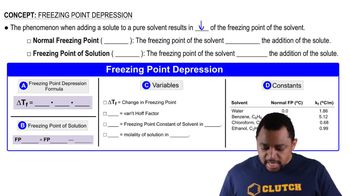
The formula is ΔTf = i ⋅ Kf ⋅ m, where 'i' is the Van't Hoff factor, 'Kf' is the freezing point depression constant, and 'm' is the molality.
What is the Van't Hoff factor in the context of freezing point depression?
The Van't Hoff factor 'i' represents the number of particles the solute dissociates into in solution.
How does the addition of solute affect the freezing point of a solution compared to the pure solvent?
The addition of solute lowers the freezing point of the solution compared to the pure solvent.
What is molality and how is it used in freezing point depression calculations?
Molality is the measure of moles of solute per kilogram of solvent and is used in the freezing point depression formula.
What is the normal freezing point of a solvent?
The normal freezing point is the temperature at which a pure solvent freezes before any solute is added.
How do you find the freezing point of a solution using the freezing point depression concept?
Subtract the change in freezing point (ΔTf) from the normal freezing point of the pure solvent.
What practical application does freezing point depression have?
Freezing point depression is used in the formulation of antifreeze solutions to lower the freezing point of liquids.
What happens to the volume of liquid water when it freezes?
The volume of liquid water increases when it freezes due to the formation of a crystalline structure.
How can the freezing of water crack boulders?
Water expands upon freezing, and this expansion can exert pressure on boulders, causing them to crack.
 BackBack

 01:59
01:59