Back

Gas Evolution Equations quiz

Control buttons has been changed to "navigation" mode.
1/15
  • What is a gas evolution equation?

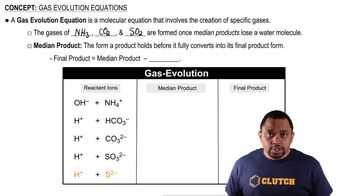
    A gas evolution equation is a molecular equation that involves the creation of specific gases as products.
  • Which gases are commonly formed in gas evolution reactions?

    The commonly formed gases are ammonia (NH3), carbon dioxide (CO2), and sulfur dioxide (SO2).
  • What is a medium (or intermediate) product in a gas evolution reaction?

    A medium product is the form of the product before it fully converts into its final gaseous form.
  • How is the final gaseous product obtained from the medium product?

    The final product is obtained by subtracting a water molecule (H2O) from the medium product.
  • What medium product forms when hydroxide ions react with ammonium ions?

    The medium product is NH4OH (ammonium hydroxide).
  • What gas is produced when NH4OH loses water?

    Ammonia gas (NH3) is produced.
  • What medium product forms when hydrogen ions react with bicarbonate ions?

    The medium product is H2CO3 (carbonic acid).
  • What gas is produced when H2CO3 loses water?

    Carbon dioxide gas (CO2) is produced.
  • What medium product forms when hydrogen ions react with sulfite ions?

    The medium product is H2SO3 (sulfurous acid).
  • What gas is produced when H2SO3 loses water?

    Sulfur dioxide gas (SO2) is produced.
  • What is unique about the formation of hydrogen sulfide (H2S) in gas evolution reactions?

    Hydrogen sulfide is already in its final gas form and does not require the loss of water.
  • What happens to the charges when ions with the same charge combine in these reactions?

    When ions with the same charge combine, their charges cancel out.
  • What happens to the charges when ions with different charges combine?

    When ions with different charges combine, the charges do not cancel out and instead crisscross to balance.
  • Why does H2S not lose water to become a gas?

    H2S does not lose water because it is already in its gaseous form and contains no oxygen to remove as water.
  • Why is understanding gas evolution reactions important in chemistry?

    It is important because it helps predict the final gaseous products formed in chemical equations.