Rutherford Gold Foil Experiment quiz #1 Flashcards

Rutherford Gold Foil Experiment quiz #1
Control buttons has been changed to "navigation" mode.
1/33
  • What did Ernest Rutherford’s gold foil experiment demonstrate about atoms?

    It showed that atoms have a small, dense, positively charged nucleus at their center.
  • What did Ernest Rutherford’s gold foil experiment demonstrate about an atom?

    It demonstrated that most of an atom's mass is concentrated in a tiny nucleus, with electrons surrounding it.
  • Which scientist developed the nuclear model of the atom?

    Ernest Rutherford developed the nuclear model of the atom.
  • Who developed the gold foil experiment?

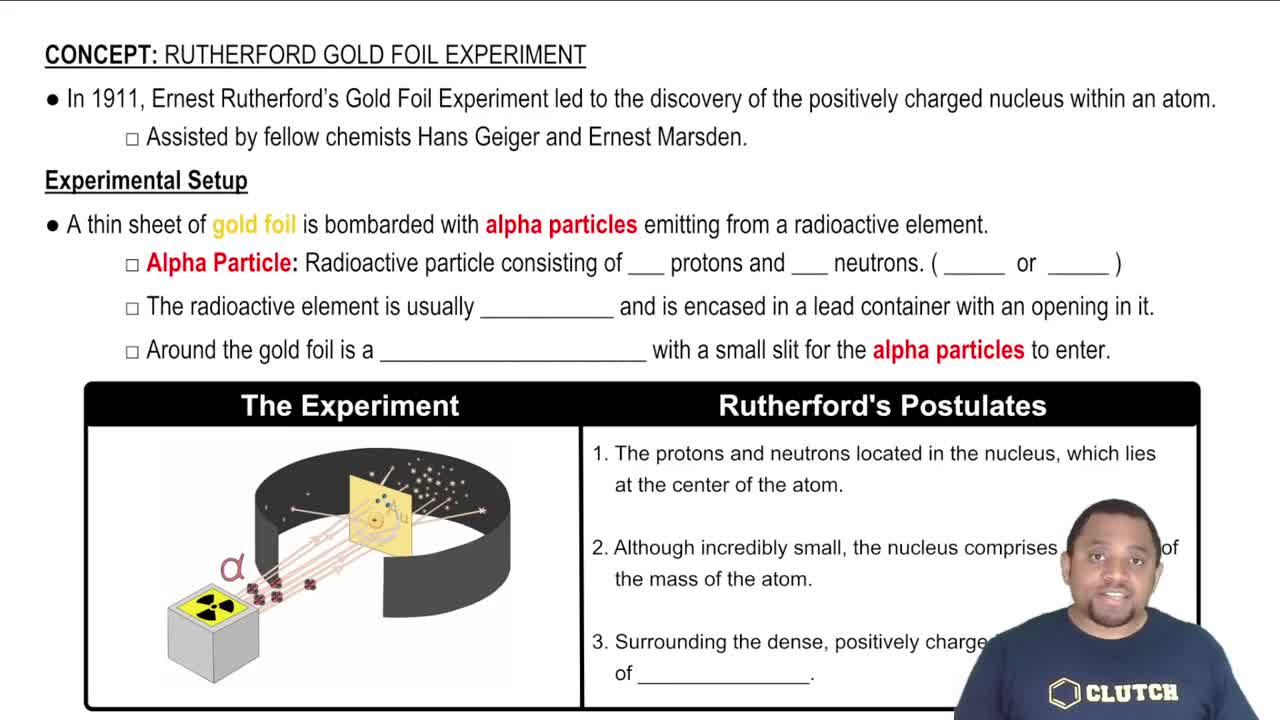
    Ernest Rutherford, assisted by Hans Geiger and Ernest Marsden, developed the gold foil experiment.
  • What caused the deflection of the alpha particles in Rutherford’s gold foil experiment?

    The deflection was caused by the alpha particles encountering the dense, positively charged nucleus of the atom.
  • Which conclusion was a direct result of the gold foil experiment?

    Atoms contain a small, dense nucleus that holds most of their mass and positive charge.
  • Which describes Ernest Rutherford’s experiment?

    Rutherford’s experiment involved firing alpha particles at a thin gold foil to study atomic structure.
  • Which conclusion was developed as a result of the gold foil experiment?

    The atom has a central nucleus where most of its mass and positive charge are concentrated.
  • Which conclusion could be made from Ernest Rutherford’s gold foil experiment?

    Most of the atom is empty space, with a dense nucleus at the center.
  • Who discovered the nucleus of the atom?

    Ernest Rutherford discovered the atomic nucleus.
  • What was Rutherford's contribution to the atom?

    Rutherford proposed the nuclear model, showing that atoms have a central nucleus.
  • What did Rutherford discover?

    Rutherford discovered the existence of the atomic nucleus.
  • What did Rutherford’s experiment prove about the atomic nucleus?

    It proved that the nucleus is small, dense, and positively charged.
  • What did Ernest Rutherford discover?

    He discovered the nucleus at the center of the atom.
  • What caused the deflection of the alpha particles in Rutherford's gold foil experiment?

    Deflection occurred when alpha particles encountered the positively charged nucleus.
  • What were the key conclusions from Rutherford's experiment?

    Atoms have a tiny, dense nucleus; most of the atom is empty space; electrons surround the nucleus.
  • What did Rutherford contribute to the model of the atom?

    He introduced the nuclear model, with a central nucleus and surrounding electrons.
  • What did he say about the particles that were deflected?

    Rutherford said that deflected particles had collided with or passed close to the dense nucleus.
  • Which conclusion directly resulted from the 'gold foil experiment'?

    The atom contains a small, dense, positively charged nucleus.
  • Which conclusion was drawn from the results of the gold foil experiment?

    Most of the atom is empty space, with a central nucleus.
  • Rutherford’s gold foil experiment provided evidence for which of the following statements?

    Atoms have a dense nucleus containing most of their mass and positive charge.
  • What was Rutherford's contribution to atomic theory?

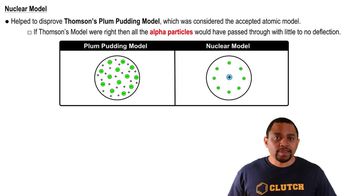
    He established the nuclear model, replacing the plum pudding model.
  • Which statement best describes the design of Rutherford's gold foil experiment?

    Alpha particles were fired at a thin gold foil, and their scattering was observed on a detecting screen.
  • Which of the following statements are consistent with Rutherford's nuclear theory?

    Atoms have a small, dense nucleus; most of the atom is empty space; electrons orbit the nucleus.
  • Why did the alpha particles bounce back during Rutherford's experiments?

    They bounced back after colliding with the dense, positively charged nucleus.
  • Who is credited with discovering the atomic nucleus?

    Ernest Rutherford is credited with discovering the atomic nucleus.
  • What was the result of Rutherford’s investigation?

    He found that atoms have a central nucleus and most of their volume is empty space.
  • Which statement describes one feature of Rutherford’s model of the atom?

    The atom has a tiny, dense nucleus surrounded by electrons.
  • Which statement best describes what Rutherford concluded from the motion of the particles?

    Most alpha particles passed through, but some were deflected by the nucleus, showing its presence.
  • Which hypothesis led to the discovery of the proton?

    The hypothesis that atoms have a dense, positively charged nucleus led to the discovery of the proton.
  • What was the purpose and outcome of the gold foil experiment performed in Rutherford's lab?

    It aimed to study atomic structure and resulted in the discovery of the nucleus.
  • Rutherford's gold foil experiment determined that

    Atoms have a small, dense, positively charged nucleus.
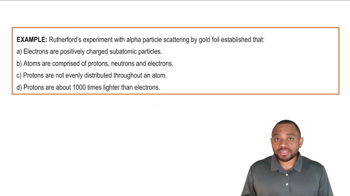
  • Rutherford's experiment with alpha particle scattering by gold foil established that

    The atom's mass and positive charge are concentrated in a central nucleus.