Heat Capacity quiz #1 Flashcards

Heat Capacity quiz #1
Control buttons has been changed to "navigation" mode.
1/40
  • What is the specific heat capacity of water?
    The specific heat capacity of water is approximately 4.18 J/g·°C.
  • If 14.5 kJ of heat were added to 485 g of liquid water, how much would its temperature increase?
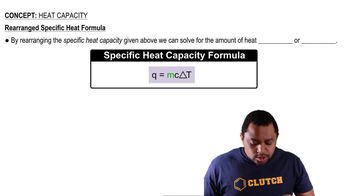
    Use q = mcΔT. ΔT = q/(mc) = 14500 J / (485 g × 4.18 J/g·°C) ≈ 7.2°C.
  • How much heat energy is needed to melt 1 gram of ice?
    The heat of fusion for ice is about 334 J/g, so 334 J is needed to melt 1 gram of ice.
  • What is the difference between heat capacity and specific heat capacity?
    Heat capacity is the amount of heat needed to raise the temperature of a given quantity of a substance, while specific heat capacity is the heat needed to raise 1 gram of a substance by 1°C or 1 K.
  • Why is water's high specific heat capacity important?
    Water's high specific heat helps regulate temperature in environments and living organisms, making it effective for heat exchange and temperature stability.
  • What property of water makes it a good medium for heat exchange in calorimetry?
    Water's high specific heat capacity allows it to absorb or release large amounts of heat with minimal temperature change.
  • What units are used to measure energy as heat?
    Heat energy is measured in joules (J) or sometimes calories (cal).
  • What is the molar heat capacity of liquid water?
    The molar heat capacity of liquid water is about 75.3 J/mol·°C.
  • What are the units of molar heat capacity?
    Molar heat capacity is measured in J/mol·°C or J/mol·K.
  • Does a substance that heats up quickly have a high or a low specific heat capacity?
    A substance that heats up quickly has a low specific heat capacity.
  • Which one of the following would have the lowest magnitude for the heat of fusion: water, iron, or gold?
    Gold would have the lowest magnitude for the heat of fusion among water, iron, and gold.
  • Approximately how much heat energy does it take to raise 1 kg of water by 1 K?
    It takes about 4180 J to raise 1 kg of water by 1 K.
  • Which takes less energy to raise the temperature of one gram one degree Celsius: water or aluminum?
    Aluminum takes less energy because its specific heat capacity is lower than water's.
  • What is the amount of energy needed to change a solid to a liquid at its melting point called?
    It is called the heat of fusion.
  • What is the molar heat capacity of Au(s) (solid gold)?
    The molar heat capacity of solid gold is about 25.4 J/mol·°C.
  • Which units express specific heat capacity?
    Specific heat capacity is expressed in J/g·°C or J/g·K.
  • Why does water’s high specific heat make it a good coolant for car radiators?
    Water absorbs a lot of heat without a large temperature increase, making it effective for cooling.
  • How many joules (J) are needed to change the temperature of 1 gram of water by 1°C?
    4.18 joules are needed to change the temperature of 1 gram of water by 1°C.
  • What is the heat required to raise the temperature of 1 g of a substance by 1°C or 1 K called?
    It is called the specific heat capacity.
  • During which phase change will two grams of water release 668 joules of heat energy?
    During freezing, as the heat of fusion for water is 334 J/g, so 2 g × 334 J/g = 668 J.
  • What is the temperature change if 400 J of energy is added to 10 grams of water?
    ΔT = q/(mc) = 400 J / (10 g × 4.18 J/g·°C) ≈ 9.6°C.
  • What must be added to increase the temperature of steam?
    Heat energy must be added to increase the temperature of steam.
  • What is the heat energy involved in a change of state called?
    It is called latent heat (such as heat of fusion or heat of vaporization).
  • What does water do with heat energy?
    Water absorbs or releases heat energy, causing its temperature to change or its state to change.
  • What is a good explanation for why water has a high specific heat capacity?
    Water's strong hydrogen bonds require more energy to increase its temperature, resulting in a high specific heat.
  • What is the energy required to raise the temperature of 1 g of a substance by 1°C or 1 K called?
    It is called specific heat capacity.
  • Which units express heat capacity?
    Heat capacity is expressed in joules per degree Celsius (J/°C) or joules per Kelvin (J/K).
  • Which statement defines specific heat capacity for a given sample?
    Specific heat capacity is the amount of heat required to raise the temperature of 1 gram of a substance by 1°C or 1 K.
  • What is the change in heat when 35.0 g of H2O freezes?
    q = m × heat of fusion = 35.0 g × 334 J/g = 11,690 J released.
  • Which statement defines the heat capacity of a sample?
    Heat capacity is the amount of heat required to raise the temperature of a given quantity of a substance by 1°C or 1 K.
  • What is the heat of combustion of ethane?
    The heat of combustion of ethane is not provided in the summary; refer to standard tables for its value.
  • How much energy is needed to convert 70.6 grams of ice at 0.00°C to water at 75.0°C?
    q = m × heat of fusion + m × c × ΔT = 70.6 g × 334 J/g + 70.6 g × 4.18 J/g·°C × 75°C ≈ 23,580 J + 22,150 J = 45,730 J.
  • Which substance is most likely to heat up the fastest: water, iron, or gold?
    Gold, because it has the lowest specific heat capacity.
  • Which substance would retain the most heat for the longest period of time: water, iron, or gold?
    Water, due to its high specific heat capacity.
  • Which has greater heat capacity—iron or water?
    Water has a greater heat capacity than iron.
  • How many grams of water can be heated from 20.0°C to 75.0°C using 12,500.0 joules?
    m = q/(cΔT) = 12,500 J / (4.18 J/g·°C × 55°C) ≈ 51.5 g.
  • What is the total amount of heat required to completely melt 347 grams of ice at its melting point?
    q = m × heat of fusion = 347 g × 334 J/g = 115,798 J.
  • Which of the following has the greatest heat resistance: water, iron, or gold?
    Water has the greatest heat resistance due to its high specific heat capacity.
  • How does heat capacity correlate with outdoor temperature on a balance point graph?
    Substances with higher heat capacity show smaller temperature changes for the same amount of heat, resulting in flatter curves on a balance point graph.
  • If 0.145 J of heat causes a 0.475°C temperature change in 1 g of a substance, what is its specific heat capacity?
    c = q/(mΔT) = 0.145 J / (1 g × 0.475°C) ≈ 0.305 J/g·°C.