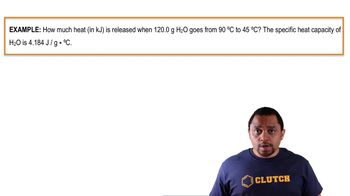
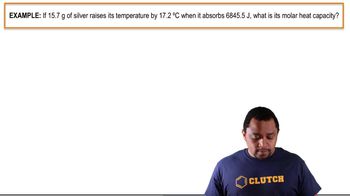
What is the formula for specific heat capacity (c)?
c = q/(mΔT), where q is heat, m is mass, and ΔT is temperature change.
What does the capital letter C represent in the context of heat capacity?
Capital C represents the heat capacity or molar heat capacity, which is the amount of heat required to raise the temperature of a given quantity or one mole of a substance by one degree.
How does the temperature change of a substance relate to the amount of heat applied?
The temperature change is directly proportional to the amount of heat applied; more heat results in a greater temperature increase.
What is the difference between specific heat capacity and molar heat capacity?
Specific heat capacity refers to the heat needed to raise the temperature of 1 gram of a substance by 1 degree, while molar heat capacity refers to the heat needed for 1 mole of a substance.
Why is it important to match the temperature units when using heat capacity formulas?
It is important because the units for temperature in the formula must match the units used for heat capacity to ensure correct calculations.
What does the variable 'n' represent in the molar heat capacity formula?
In the molar heat capacity formula, 'n' represents the number of moles of the substance.
How can the specific heat capacity formula be rearranged to solve for the heat absorbed or released?
The formula can be rearranged to q = m × c × ΔT, allowing calculation of the heat absorbed or released.
What mnemonic is suggested to help remember the formula for heat absorbed or released in terms of specific heat capacity?
The mnemonic 'MCAT' is suggested, corresponding to the formula q = m × c × ΔT.