Back

Hess's Law quiz

Control buttons has been changed to "navigation" mode.
1/15
  • What does Hess's Law allow us to determine in a chemical reaction?

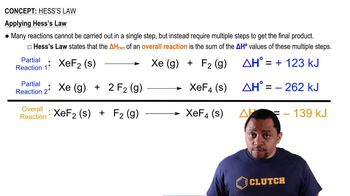
    Hess's Law allows us to determine the enthalpy change (ΔHrxn) of an overall reaction by summing the enthalpy changes of individual steps.
  • What happens to ΔHrxn if you multiply the coefficients in a thermochemical equation by 2?

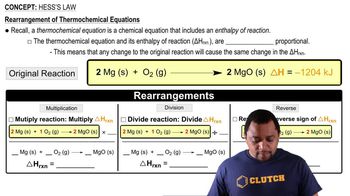
    ΔHrxn must also be multiplied by 2, so the enthalpy change doubles.
  • How does dividing the coefficients in a thermochemical equation by 2 affect ΔHrxn?

    ΔHrxn must be divided by 2, so the enthalpy change is halved.
  • What effect does reversing a thermochemical equation have on ΔHrxn?

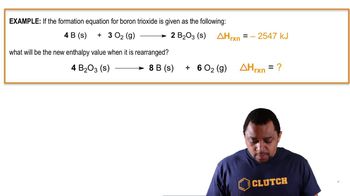
    Reversing the equation reverses the sign of ΔHrxn; a negative value becomes positive and vice versa.
  • What is a thermochemical equation?

    A thermochemical equation is a chemical equation that includes the enthalpy of reaction (ΔHrxn).
  • What must you do to ΔHrxn when you manipulate the coefficients of a thermochemical equation?

    Any change to the coefficients must be applied to ΔHrxn in the same way, such as multiplying or dividing by the same factor.
  • What is the main principle of Hess's Law regarding reaction pathways?

    The total enthalpy change for a reaction is the same regardless of the pathway, as long as the initial and final conditions are the same.
  • How are intermediate species treated when combining thermochemical equations using Hess's Law?

    Intermediate species that appear on both sides of the combined reactions are canceled out.
  • Why is Hess's Law useful for reactions that cannot be carried out in a single step?

    It allows us to calculate the overall enthalpy change by summing the enthalpy changes of multiple steps.
  • What happens to the enthalpy value if a reaction is reversed?

    The sign of the enthalpy value is reversed; negative becomes positive and positive becomes negative.
  • How do you find the overall ΔHrxn for a reaction using Hess's Law?

    You add up the enthalpy values of the individual steps to get the overall ΔHrxn.
  • What are reaction intermediates in the context of Hess's Law?

    Reaction intermediates are species that appear as both reactants and products in combined equations and are canceled out.
  • What is the relationship between a thermochemical equation and its enthalpy of reaction?

    They are directly proportional; any change to the equation causes the same change in ΔHrxn.
  • What must be true for Hess's Law to apply to a set of reactions?

    The initial and final conditions must be the same for the overall reaction.
  • What is the result of combining partial reactions according to Hess's Law?

    Combining partial reactions gives the overall reaction and its associated overall enthalpy change.