Back

Hybridization quiz

Control buttons has been changed to "navigation" mode.
1/15
  • What is hybridization in chemistry?

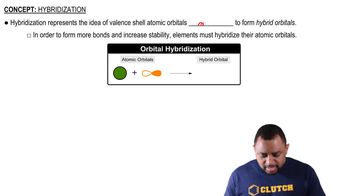
    Hybridization is the mixing of atomic orbitals to form new hybrid orbitals, allowing elements to form more bonds and increase stability.
  • Which atomic orbitals typically mix during hybridization?

    The s and p orbitals typically mix during hybridization, and sometimes d orbitals are included for larger electron groups.
  • How does hybridization relate to molecular shape?

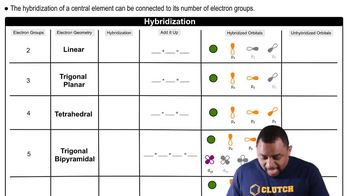
    Hybridization of the central atom correlates with the number of electron groups, which determines the molecular shape.
  • What is the hybridization for a molecule with two electron groups?

    The hybridization is sp, meaning one s and one p orbital are mixed, resulting in a linear geometry.
  • How many p orbitals are left unhybridized in sp hybridization?

    Two p orbitals remain unhybridized when sp hybridization occurs.
  • What is the hybridization for a molecule with three electron groups?

    The hybridization is sp2, involving one s and two p orbitals, resulting in a trigonal planar geometry.
  • How many p orbitals are left unhybridized in sp2 hybridization?

    One p orbital remains unhybridized in sp2 hybridization.
  • What is the hybridization for a molecule with four electron groups?

    The hybridization is sp3, involving one s and three p orbitals, resulting in a tetrahedral geometry.
  • How many unhybridized orbitals are left in sp3 hybridization?

    There are zero unhybridized orbitals left in sp3 hybridization.
  • What is the hybridization for a molecule with five electron groups?

    The hybridization is sp3d, involving one s, three p, and one d orbital, resulting in a trigonal bipyramidal geometry.
  • How many d orbitals are left unhybridized in sp3d hybridization?

    Four d orbitals remain unhybridized in sp3d hybridization.
  • What is the hybridization for a molecule with six electron groups?

    The hybridization is sp3d2, involving one s, three p, and two d orbitals, resulting in an octahedral geometry.
  • How many d orbitals are left unhybridized in sp3d2 hybridization?

    Three d orbitals remain unhybridized in sp3d2 hybridization.
  • How can you determine the hybridization of a central atom?

    Count the number of electron groups around the central atom and match it to the corresponding hybridization type.
  • Why is understanding hybridization important for predicting molecular shapes?

    Hybridization helps predict which orbitals are involved in bonding and the resulting molecular geometry.