Integrated Rate Law definitions Flashcards
Integrated Rate Law definitions
You can tap to flip the card.
Control buttons has been changed to "navigation" mode.
1/15
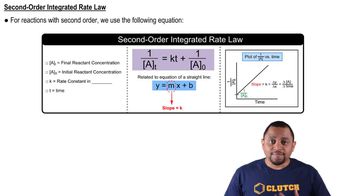
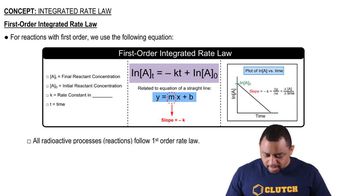
Integrated Rate LawDescribes the relationship between reactant concentrations and time, varying with reaction order.Zero Order ReactionReaction where concentration decreases linearly over time, with rate constant units of molarity per time.First Order ReactionReaction where the natural logarithm of concentration versus time is linear, with rate constant units of time inverse.Second Order ReactionReaction where the inverse of concentration versus time is linear, with rate constant units of molarity inverse per time.Rate ConstantA proportionality constant in rate laws, with units dependent on the reaction order.Reaction OrderDetermines the power to which the concentration of a reactant is raised in the rate law.MolarityA measure of concentration, expressed as moles of solute per liter of solution.Natural LogarithmThe logarithm to the base e, used in first order reaction rate equations.Radioactive ProcessA process that follows first order kinetics, often involving decay of isotopes.SlopeIn rate law graphs, represents the rate constant, negative for zero and first order, positive for second order.ConcentrationThe amount of a substance in a given volume, crucial in determining reaction rates.Time InverseUnits of rate constant for first order reactions, indicating per unit time.PlotA graphical representation of data, used to identify reaction order by the relationship between variables.Initial ConcentrationThe concentration of reactants at the start of a reaction, denoted as a sub 0.Final ConcentrationThe concentration of reactants at a given time during a reaction, denoted as a sub t.