Intermolecular Forces quiz #2 Flashcards

Intermolecular Forces quiz #2
Control buttons has been changed to "navigation" mode.
1/40
  • Which are examples of intermolecular forces?

    Examples include hydrogen bonding, dipole-dipole, and London dispersion forces.
  • What is the strongest intermolecular force?

    Ion-dipole force is the strongest intermolecular force.
  • What types of particles can participate in dipole-dipole interactions?

    Polar molecules can participate in dipole-dipole interactions.
  • Why do water and oil not mix?

    Water and oil do not mix because water is polar and oil is nonpolar, so their intermolecular forces are incompatible.
  • Which of the following is the type of bond between molecules of water in a beaker of water?

    Hydrogen bonds are the type of attraction between water molecules.
  • Which one of the following exhibits dipole-dipole attraction between molecules?

    A polar molecule such as SO2 exhibits dipole-dipole attraction between molecules.
  • Which intermolecular force is found in all molecules?

    London dispersion forces are found in all molecules.
  • Which of the following compounds exhibits hydrogen bonding?

    Compounds with H bonded to F, O, or N, such as NH3, exhibit hydrogen bonding.
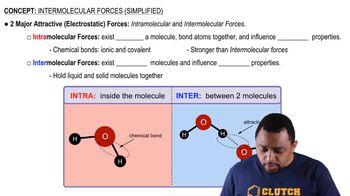
  • What is the difference between intramolecular and intermolecular forces?

    Intramolecular forces hold atoms together within a molecule; intermolecular forces attract molecules to each other.
  • Which intermolecular force plays a pivotal role in the unique properties of water?

    Hydrogen bonding plays a pivotal role in water's unique properties.
  • What types of forces exist between I2 molecules?

    I2 molecules experience London dispersion forces.
  • Which of the following have the strongest intermolecular forces?

    Ionic compounds dissolved in water have the strongest intermolecular forces (ion-dipole).
  • How do intermolecular forces compare with intramolecular forces in terms of strength?

    Intermolecular forces are much weaker than intramolecular forces.
  • Which type of attraction results from the formation of weak momentary dipoles?

    London dispersion forces result from weak momentary dipoles.
  • What types of intermolecular forces are found in CH2Cl2?

    CH2Cl2 has dipole-dipole and London dispersion forces.
  • Which is the strongest intermolecular forces of attraction between molecules?

    Ion-dipole forces are the strongest intermolecular forces of attraction.
  • Which of the following is the strongest intermolecular force?

    Ion-dipole force is the strongest intermolecular force.
  • What is the strongest interparticle force in a sample of solid MgCl2?

    Ion-dipole forces are the strongest in MgCl2 when dissolved in water; in solid MgCl2, ionic bonds (intramolecular) dominate.
  • Which is expected to have the largest dispersion forces?

    A large, heavy atom or molecule like Xe or I2 is expected to have the largest dispersion forces.
  • Which molecule below has hydrogen bonding?

    A molecule with H bonded to O, N, or F, such as H2O, has hydrogen bonding.
  • What type of intermolecular force exists between the permanent dipoles of two polar molecules?

    Dipole-dipole forces exist between permanent dipoles of polar molecules.
  • Why are intermolecular forces important?

    Intermolecular forces determine physical properties like boiling point, melting point, and solubility.
  • What is the strongest type of intermolecular force present between separate water molecules?

    Hydrogen bonding is the strongest intermolecular force between water molecules.
  • What is the strongest type of intermolecular force that would exist between CH4 molecules?

    London dispersion forces are the strongest between CH4 molecules.
  • Which of the following bonds must break for water to change from a liquid to a gas?

    Intermolecular hydrogen bonds must break for water to vaporize.
  • Which state of matter will have a greater force of intermolecular attraction?

    Solids have the greatest force of intermolecular attraction.
  • What name is given to intermolecular forces that occur due to the polarity of two molecules?

    Dipole-dipole forces occur due to the polarity of two molecules.
  • What is demonstrated when you see beads of water on a waxed car hood?

    High surface tension due to hydrogen bonding is demonstrated.
  • Which of the following substances has the strongest intermolecular forces?

    An ionic compound dissolved in water has the strongest intermolecular forces (ion-dipole).
  • How is a polar molecule different from a nonpolar molecule?

    A polar molecule has an uneven distribution of charge; a nonpolar molecule has an even distribution.
  • What type(s) of intermolecular forces are expected between molecules?

    London dispersion, dipole-dipole, hydrogen bonding, or ion-dipole forces may be expected depending on the molecules.
  • What is the dominant IMF in a mixture of NH3 and KCl?

    Ion-dipole forces are dominant in a mixture of NH3 and KCl.
  • What force in liquids causes surface tension?

    Strong intermolecular forces, especially hydrogen bonding, cause surface tension in liquids.
  • Which of the following is the weakest bond or force in the presence of water?

    London dispersion forces are the weakest in the presence of water.
  • What is the strongest type of intermolecular force that exists between these two molecules?

    The strongest force depends on the molecules; if H is bonded to F, O, or N, hydrogen bonding is strongest.
  • Which substance below has dipole-dipole forces?

    A polar molecule such as SO2 has dipole-dipole forces.
  • Which intermolecular force is due to the formation of an instantaneous dipole?

    London dispersion forces are due to instantaneous dipoles.
  • Which outcome is a direct result of hydrogen bonding?

    High boiling point and high surface tension are direct results of hydrogen bonding.
  • What is the cause of surface tension?

    Surface tension is caused by strong intermolecular forces at the liquid's surface.
  • Oil and water are immiscible. Which is the most likely reason?

    Oil is nonpolar and water is polar, so their intermolecular forces do not allow mixing.