Intermolecular Forces quiz #4 Flashcards

Intermolecular Forces quiz #4
Control buttons has been changed to "navigation" mode.
1/40
  • Which substance below has the strongest intermolecular forces?

    An ionic compound dissolved in water has the strongest intermolecular forces (ion-dipole).
  • What type(s) of intermolecular forces are expected between PO(OH)3 molecules?

    PO(OH)3 molecules have hydrogen bonding, dipole-dipole, and London dispersion forces.
  • Based on intermolecular forces, which compound would have the highest boiling point?

    A compound with strong hydrogen bonding, such as H2O, would have the highest boiling point.
  • What is the strongest intermolecular attraction between two molecules of this type?

    The strongest attraction depends on the molecule; hydrogen bonding if H is bonded to F, O, or N.
  • Which of these is not an intermolecular force?

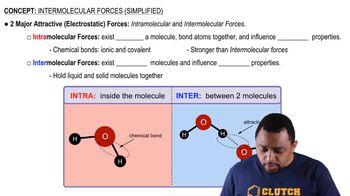
    Covalent bonds are not intermolecular forces.
  • Why does oil and water not mix?

    Oil is nonpolar and water is polar, so their intermolecular forces do not allow mixing.
  • Which of the forces of molecular attraction is the weakest?

    London dispersion forces are the weakest molecular attraction.
  • What type(s) of intermolecular forces are expected between NH3 molecules?

    NH3 molecules have hydrogen bonding, dipole-dipole, and London dispersion forces.
  • Intermolecular forces are weakest in which type of compound?

    Intermolecular forces are weakest in nonpolar compounds.
  • Which molecules have dipole-dipole forces?

    Polar molecules have dipole-dipole forces.
  • Which of the following is a typical value for a hydrogen bond?

    A typical hydrogen bond energy is 10–40 kJ/mol.
  • Which of the following is not an example of an intermolecular force?

    Ionic and covalent bonds are not examples of intermolecular forces.
  • Which molecule will engage in the strongest dispersion forces?

    A large, heavy molecule like I2 will engage in the strongest dispersion forces.
  • Which of the following molecules could form hydrogen bonds with an identical molecule?

    Molecules with H bonded to O, N, or F, such as NH3, can form hydrogen bonds with identical molecules.
  • What type of inter-molecular force arises from instantaneous dipole moments?

    London dispersion forces arise from instantaneous dipole moments.
  • What are dipole-dipole forces?

    Dipole-dipole forces are attractions between polar molecules due to their permanent dipoles.
  • What are dipole-dipole interactions?

    Dipole-dipole interactions are attractive forces between polar molecules.
  • Which molecule below would be affected the most by intermolecular forces? CH3OH vs. CH4

    CH3OH would be affected the most due to hydrogen bonding.
  • Which of the following is not an intermolecular attraction?

    Covalent bonds are not intermolecular attractions.
  • What is the weakest intermolecular force?

    London dispersion forces are the weakest intermolecular force.
  • What physically breaks hydrogen bonds between water molecules as ice melts?

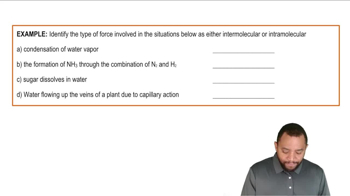
    Heat energy physically breaks hydrogen bonds as ice melts.
  • Which intermolecular force is the weakest?

    London dispersion force is the weakest intermolecular force.
  • What causes dipole-dipole intermolecular forces?

    Dipole-dipole forces are caused by attractions between permanent dipoles in polar molecules.
  • Which type of bond must be broken for water to vaporize?

    Intermolecular hydrogen bonds must be broken for water to vaporize.
  • Which compound(s) exhibit only London dispersion intermolecular forces?

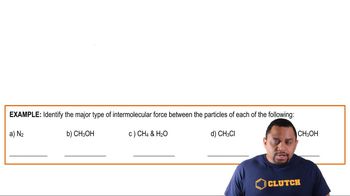
    Nonpolar compounds like CH4 and CCl4 exhibit only London dispersion forces.
  • Which type of interparticle forces leads to compounds with the lowest melting points?

    London dispersion forces lead to compounds with the lowest melting points.
  • Which of the following compounds will form hydrogen bonds between its molecules?

    Compounds with H bonded to O, N, or F, such as NH3, will form hydrogen bonds between molecules.
  • Which one of the following substances crystallizes as a molecular solid?

    A substance like I2 crystallizes as a molecular solid.
  • Which of the following properties indicates the presence of weak intermolecular forces in a liquid?

    A low boiling point indicates weak intermolecular forces in a liquid.
  • What types of intermolecular forces are found in H2CO?

    H2CO has dipole-dipole and London dispersion forces.
  • Which is the strongest interparticle force in a sample of BrF?

    Dipole-dipole forces are the strongest in BrF.
  • Which substances exhibit only London (dispersion) forces?

    Nonpolar substances like CH4 and CCl4 exhibit only London dispersion forces.
  • Which molecule will have hydrogen bonding as its strongest type of intermolecular force?

    A molecule like CH3OH will have hydrogen bonding as its strongest force.
  • Which is the strongest interparticle force present in a sample of H3PO4?

    Hydrogen bonding is the strongest force in H3PO4.
  • Which of the following intermolecular forces is the strongest?

    Ion-dipole force is the strongest intermolecular force.
  • Which of the following molecules will not participate in dipole-dipole interactions?

    Nonpolar molecules like CH4 will not participate in dipole-dipole interactions.
  • What is the strongest type of intermolecular force present in CHF3?

    Dipole-dipole forces are the strongest in CHF3.
  • Which molecule will experience hydrogen bonding with like molecules?

    A molecule like NH3 will experience hydrogen bonding with like molecules.
  • What is required for dipole-dipole forces to exist between two molecules?

    Both molecules must be polar for dipole-dipole forces to exist.
  • What is the strongest type of intermolecular force of attraction present in C3H8?

    London dispersion forces are the strongest in C3H8.