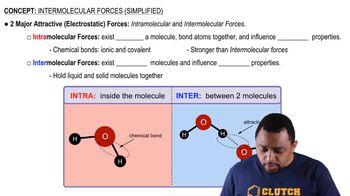
Water has surface tension because of strong hydrogen bonding between molecules.
Which term identifies a type of intermolecular force?
Dipole-dipole is a type of intermolecular force.
____ ____ force is the type of intermolecular force that would be present between molecules of Cl2.
London dispersion force is present between Cl2 molecules.
Based on table H, which compound has the strongest intermolecular forces at 60 kPa?
The compound with the lowest vapor pressure at 60 kPa has the strongest intermolecular forces.
What intermolecular forces are present between two molecules of CH3CF3?
CH3CF3 molecules have dipole-dipole and London dispersion forces.
The strongest intermolecular force is ____ ____.
Ion-dipole.
The only substance with a higher surface tension than water is _____.
Mercury.
Neon atoms are attracted to each other by
London dispersion forces.
A measure of how difficult it is to stretch or break the surface of a liquid
Surface tension.
Intermolecular forces allow which substance to be the least fluid?
A substance with strong intermolecular forces, such as water, is the least fluid.
Ice is held together in a ________ structure.
Hydrogen-bonded lattice structure.
The predominant intermolecular force found in Na+(aq) is _____
Ion-dipole force.
Identify the type of intermolecular force(s) between NH3 and another NH3 molecule.
Hydrogen bonding, dipole-dipole, and London dispersion forces.
Which of the following best describes very weak, brief attractions between neutral atoms?
London dispersion forces.
The partial charges across one molecule of water occur because of
Differences in electronegativity between hydrogen and oxygen.
Does soap break hydrogen bonds?
Soap can disrupt hydrogen bonds, reducing water's surface tension.
A hydrogen atom in a given water molecule is strongly attracted to
The oxygen atom in a neighboring water molecule.
Does Cl2 have dipole-dipole forces?
No, Cl2 is nonpolar and only has London dispersion forces.
What kinds of attractive forces may exist between particles in molecular crystals?
London dispersion, dipole-dipole, and hydrogen bonding may exist in molecular crystals.
Polar attractions are
Polar attractions are dipole-dipole interactions between polar molecules.
The predominant intermolecular force between molecules of I2 is _____
London dispersion force.
Polarity and intermolecular forces gizmo
Polarity determines the type of intermolecular forces present: polar molecules have dipole-dipole and possibly hydrogen bonding; nonpolar have only dispersion.
Why is I2 a solid at room temperature?
I2 is a solid due to strong London dispersion forces from its large size and many electrons.
NH3 intermolecular forces
NH3 has hydrogen bonding, dipole-dipole, and London dispersion forces.
HCLO intermolecular forces
HCLO has dipole-dipole and London dispersion forces.
Which compound would you expect to have greater surface tension, acetone [(CH3)2CO] or water (H2O)?
Water (H2O) has greater surface tension due to hydrogen bonding.
In a pure sample of HF, what forces of attraction exist between the molecules?
HF molecules have hydrogen bonding, dipole-dipole, and London dispersion forces.
What is the strongest type of intermolecular force present in NH2CH3?
Hydrogen bonding is the strongest force in NH2CH3.
Rank the following based on increasing intermolecular forces: C2H6, C4H10, C6H14, C8H18
C2H6 < C4H10 < C6H14 < C8H18 (increasing London dispersion forces with size).
Decide which intermolecular forces act between the molecules of each compound in the table below.
Each compound may have London dispersion, dipole-dipole, or hydrogen bonding depending on its structure.
Identify the predominant intermolecular force.
The predominant force depends on the substance: ion-dipole, hydrogen bonding, dipole-dipole, or dispersion.
Identify the intermolecular forces present in each of these substances.
Each substance may have London dispersion, dipole-dipole, hydrogen bonding, or ion-dipole forces.
List the intermolecular forces present in the following molecule:
Depending on the molecule, possible forces include London dispersion, dipole-dipole, and hydrogen bonding.
Ammonia's unusually high melting point is the result of
Hydrogen bonding.
Rank the following in order of increasing strength of their respective intermolecular forces.
London dispersion < dipole-dipole < hydrogen bonding < ion-dipole.
Identify which of the following molecules can exhibit hydrogen bonding as a pure liquid.
Molecules with H bonded to O, N, or F, such as H2O and NH3, can exhibit hydrogen bonding.
List the intermolecular forces present in the following molecule.
Depending on the molecule, possible forces include London dispersion, dipole-dipole, and hydrogen bonding.
Water molecules stay close to each other as a result of existence of
Hydrogen bonding.
Identify the true statements about surface tension.
Surface tension is caused by strong intermolecular forces and allows liquids to form beads.