Intro to Acid-Base Titration Curves definitions Flashcards

Intro to Acid-Base Titration Curves definitions
Control buttons has been changed to "navigation" mode.
1/15
  • Titrant
    A solution with known concentration used to neutralize the titrate in a titration process.
  • Titrate
    An acidic or basic solution with unknown concentration neutralized by the titrant.
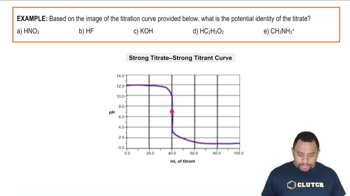
  • Titration Curve
    A graph plotting pH against the volume of titrant added during a titration.
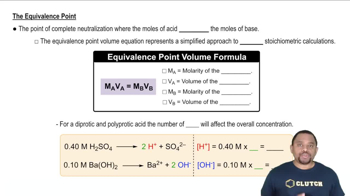
  • Equivalence Point
    The point in a titration where moles of acid equal moles of base, indicating complete neutralization.
  • Molarity
    A measure of concentration, representing moles of solute per liter of solution.
  • Stoichiometry
    The calculation of reactants and products in chemical reactions, simplified in titration by a specific formula.
  • Diprotic Acid
    An acid that can donate two protons or hydrogen ions per molecule in a reaction.
  • Polyprotic Acid
    An acid that can donate more than one proton or hydrogen ion per molecule.
  • Sigmoidal Curve
    The S-shaped curve observed in titrations involving strong acids and bases.
  • Burette
    A laboratory apparatus used to dispense precise volumes of liquid, especially in titrations.
  • Neutralization
    A chemical reaction in which an acid and a base react to form water and a salt.
  • Strong Base
    A base that completely dissociates in solution, providing a high concentration of OH- ions.
  • Strong Acid
    An acid that completely dissociates in solution, providing a high concentration of H+ ions.
  • Volume
    The amount of space that a substance or object occupies, crucial in titration calculations.
  • pH
    A scale used to specify the acidity or basicity of an aqueous solution.