Ions quiz #3 Flashcards

Ions quiz #3
Control buttons has been changed to "navigation" mode.
1/40
  • What is the charge of the hydrogen atoms due to the unequal pull of electrons in a polar bond?
    Hydrogen atoms have a partial positive charge (δ+) in a polar bond.
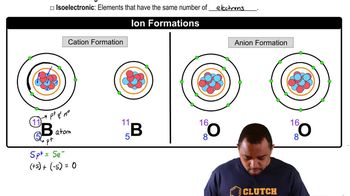
  • What is the difference between an atom and an ion?
    An atom is neutral with equal numbers of protons and electrons, while an ion has gained or lost electrons and carries a net charge.
  • How many hydroxide ions are bonded to each aluminum ion in aluminum hydroxide?
    Three hydroxide ions are bonded to each aluminum ion.
  • What is the charge on a hydronium ion?
    The charge on a hydronium ion (H3O+) is +1.
  • An atom X has three electrons in its outermost shell. Which ion will most likely be formed by X?
    X will most likely form a 3+ cation by losing three electrons.
  • What must happen to an atom of magnesium in order to become a magnesium ion (Mg2+)?
    A magnesium atom must lose two electrons to become Mg2+.
  • What is the charge of a hydroxide ion?
    The charge of a hydroxide ion (OH-) is -1.
  • Why do atoms form ions?
    Atoms form ions to achieve a stable electron configuration, often resembling that of noble gases.
  • What is the charge of an ion that has only protons?
    An ion with only protons and no electrons would have a positive charge equal to the number of protons.
  • Which of the following is an anion?
    An anion is a negatively charged ion, such as Cl-.
  • Which of the following pairs of ions represent isoelectronic species?
    Na+ and F- are isoelectronic, both having 10 electrons.
  • Which particles in an atom carry an electric charge of -1?
    Electrons carry a charge of -1.
  • How many protons and electrons are found in a Sc3+ ion?
    Sc3+ has 21 protons and 18 electrons.
  • What is the ratio of Al ions to S ions in a neutral compound?
    The ratio is 2 Al^3+ ions to 3 S^2- ions (2:3).
  • An atom that loses a negatively-charged electron becomes a(n)?
    It becomes a cation.
  • Which of the following species are isoelectronic with Ne?
    Na+, F-, and Mg2+ are isoelectronic with Ne.
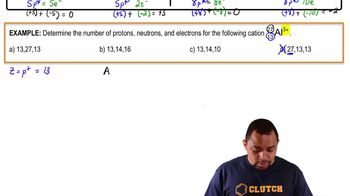
  • Which one of the following compounds contains an ion with a 3+ charge?
    AlCl3 contains Al3+ ions.
  • What is a hydronium ion?
    A hydronium ion is H3O+, formed when a hydrogen ion associates with water.
  • What is the charge of an anion?
    An anion has a negative charge.
  • Which process changes a chlorine atom into a negative chloride ion?
    Chlorine gains one electron to become Cl-.
  • What is the net charge of an ion that has 11 protons?
    The net charge depends on the number of electrons; if it has 10 electrons, the charge is +1.
  • If an element loses an electron, what type of ion does it become?
    It becomes a cation.
  • Which ion is isoelectronic with krypton?
    Br- is isoelectronic with krypton (Kr).
  • What is a hydrogen ion?
    A hydrogen ion (H+) is a proton, formed when hydrogen loses its electron.
  • Which of the following is a cation?
    Na+ is a cation.
  • Which of the following has a negative charge?
    Anions, such as Cl-, have a negative charge.
  • What happens to the size of an atom when it becomes a negative ion?
    The size increases when an atom becomes a negative ion (anion).
  • Which of the following is most likely to form a cation?
    Metals are most likely to form cations.
  • Which changes in both charge and radius occur when an atom loses an electron?
    The atom becomes positively charged and its radius decreases.
  • What is an anion and where can you find it on the periodic table?
    An anion is a negatively charged ion, usually formed by nonmetals found on the right side of the periodic table.
  • Which one of the atoms shown would be most likely to form a cation with a charge of +1?
    Alkali metals (Group 1 elements) are most likely to form +1 cations.
  • What is the charge of a magnesium ion?
    A magnesium ion has a charge of +2.
  • Which of the following is not a cation?
    Cl- is not a cation; it is an anion.
  • How do ions form?
    Ions form when atoms gain or lose electrons.
  • What happens when an atom gains an electron?
    It becomes a negatively charged ion (anion).
  • Which of these is an ion?
    Na+, Cl-, and SO4^2- are ions.
  • Do metals form anions or cations?
    Metals form cations.
  • Which ion is isoelectronic with xenon?
    I- is isoelectronic with xenon.
  • Which of the following is an isoelectronic series?
    O2-, F-, Ne, Na+, and Mg2+ form an isoelectronic series (10 electrons).
  • Which element is most likely to form an ion with a negative 2 charge?
    Oxygen is most likely to form a -2 ion.