Ions quiz #5 Flashcards

Ions quiz #5
Control buttons has been changed to "navigation" mode.
1/40
  • What is a cation? What is an anion?
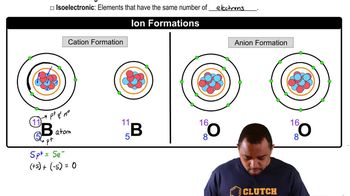
    A cation is a positively charged ion; an anion is a negatively charged ion.
  • How many electrons are in Br-?
    Br- has 36 electrons.
  • How many electrons may you remove at one time from an atom?
    You may remove as many electrons as needed to form the desired ion, depending on the atom's electron configuration.
  • Which one of the atoms shown would be most likely to form an anion with a charge of -1?
    Halogens (Group 17 elements) are most likely to form -1 anions.
  • How does an anion form?
    An anion forms when an atom gains electrons.
  • Which of the following describes a molecule that had an electron removed?
    It is a cation.
  • Why does the chloride ion have a -1 charge?
    Chloride has one more electron than protons, resulting in a -1 charge.
  • Which one of the following elements forms two or more ions with different ionic charges?
    Iron (Fe) forms Fe2+ and Fe3+ ions.
  • What is the charge on a chloride ion?
    A chloride ion has a charge of -1.
  • How is a cation formed?
    A cation is formed when an atom loses electrons.
  • What are cations and anions?
    Cations are positively charged ions; anions are negatively charged ions.
  • What is the net charge of an ion that consists of 10 electrons?
    The net charge depends on the number of protons; for example, Na+ has 11 protons and 10 electrons, so the charge is +1.
  • How are cations formed?
    Cations are formed when atoms lose electrons.
  • Which corresponds to the composition of the ion typically formed by magnesium?
    Mg2+ has 12 protons and 10 electrons.
  • Which following ions share an electron configuration with a noble gas?
    Na+, F-, and Mg2+ share electron configurations with noble gases.
  • Which ion is formed when an atom of fluorine (F) gains one electron?
    F- is formed when fluorine gains one electron.
  • How do positive ions and negative ions form?
    Positive ions (cations) form by losing electrons; negative ions (anions) form by gaining electrons.
  • To become a negative ion, what must an atom do?
    An atom must gain electrons to become a negative ion.
  • Which of the following would you expect to form a cation?
    Metals are expected to form cations.
  • Does a cation gain protons to form a positive charge or does it lose electrons?
    A cation loses electrons to form a positive charge.
  • What ion is formed when an atom of magnesium (Mg) loses two electrons?
    Mg2+ is formed when magnesium loses two electrons.
  • How does an ion differ from an atom?
    An ion has a net charge; an atom is neutral.
  • An atom of calcium loses two electrons. What is the charge on an ion of calcium?
    The charge is +2.
  • If an atom loses two electrons, what charge will it have?
    It will have a +2 charge.
  • Which formula represents a hydronium ion?
    H3O+ represents a hydronium ion.
  • What is the charge of an ion that has 19 protons?
    The charge depends on the number of electrons; if it has 18 electrons, the charge is +1.
  • What is the difference between a neutral element and an ion?
    A neutral element has equal protons and electrons; an ion has a net charge.
  • Which change occurs when a barium atom loses two electrons?
    It becomes a Ba2+ cation.
  • What is the symbol for the ion with 19 protons and 18 electrons?
    K+ is the symbol for this ion.
  • What is the charge of the common ion formed by each of these atoms?
    It depends on the atom; for example, Na forms Na+ and Cl forms Cl-.
  • Which ion has the same electron configuration as an atom of He?
    Li+ and H- have the same electron configuration as He.
  • What is the charge on a sodium ion?
    A sodium ion has a charge of +1.
  • Does calcium lose or gain electrons?
    Calcium loses electrons to form Ca2+.
  • Sulfur can form ions with a -2 charge. Is it a cation or an anion?
    Sulfur with a -2 charge is an anion.
  • How is an ion different from an atom?
    An ion has a net charge; an atom is neutral.
  • How is a standard hydrogen atom different from a hydrogen ion?
    A hydrogen atom has one electron; a hydrogen ion (H+) has none.
  • What charge does the oxygen atom hold?
    A neutral oxygen atom has no charge; as an ion (O2-), it has a -2 charge.
  • If an unknown monatomic ion with a 3- charge has 10 electrons, what is its identity?
    It is N3- (nitride ion).
  • How many electrons does the iron ion have when it forms the ionic compound FeCl3?
    Fe3+ has 23 electrons.
  • To form a stable ion, what must an atom do?
    It must gain or lose electrons to achieve a full valence shell.