Ions quiz #6 Flashcards

Ions quiz #6
Control buttons has been changed to "navigation" mode.
1/40
  • Indium has a charge of -3. How many protons and how many electrons does it have?
    Indium has 49 protons and 52 electrons.
  • Which one of these elements will readily form an ion with a 1- charge in an ionic compound?
    Chlorine will readily form a 1- ion.
  • What is an oxide ion?
    An oxide ion is O2-, formed when oxygen gains two electrons.
  • Which set of properties properly describes a bromine-79 atom with a -1 charge?
    It has 35 protons, 44 neutrons, and 36 electrons.
  • Iodine has a charge of -1. How many electrons does it have?
    I- has 54 electrons.
  • Aluminum is a group 3A metal. Which ion does Al typically form?
    Aluminum typically forms Al3+.
  • What is the charge of the magnesium ion?
    The charge is +2.
  • Which corresponds to the composition of the ion typically formed by fluorine?
    F- has 9 protons and 10 electrons.
  • What type of elements typically become negatively charged ions?
    Nonmetals typically become negatively charged ions (anions).
  • Which of the following happens when potassium forms an ion?
    Potassium loses one electron to form K+.
  • Why does sodium become positive by losing 1 electron?
    Losing a negative electron leaves sodium with a net positive charge.
  • Why is an anion negative?
    An anion is negative because it has gained electrons.
  • Which of the following is an example of an anion?
    Cl- is an example of an anion.
  • What did cations do to become positive?
    Cations lost electrons.
  • What is the charge of the fluoride ion?
    The charge of the fluoride ion (F-) is -1.
  • Why does sodium (Na) always form an ion with a 1+ charge?
    Sodium loses one electron to achieve a stable configuration, resulting in a +1 charge.
  • Which of the following would be classified as a monatomic element?
    Noble gases are monatomic elements.
  • What are negatively charged ions called?
    Negatively charged ions are called anions.
  • Which of the following is an atom that has lost an electron?
    A cation is an atom that has lost an electron.
  • How many electrons does Na+ contain?
    Na+ contains 10 electrons.
  • What type of elements form cations?
    Metals form cations.
  • Why are anions negative?
    Anions are negative because they have more electrons than protons.
  • Do the positive and negative charges balance in a neutral compound?
    Yes, positive and negative charges balance in a neutral compound.
  • How does a cation form?
    A cation forms when an atom loses electrons.
  • How many ions would you expect MgBr2 to break down into in water?
    MgBr2 breaks down into three ions: one Mg2+ and two Br-.
  • Which of these is a cation?
    Na+ is a cation.
  • What types of elements form cations?
    Metals form cations.
  • What is the name given to an atom that gains or loses electrons in a chemical reaction?
    It is called an ion.
  • What are all the ions present in the reactants of calcium chloride and sodium phosphate?
    Ca2+, Cl-, Na+, and PO4^3- are present.
  • What types of atoms form cations?
    Metal atoms form cations.
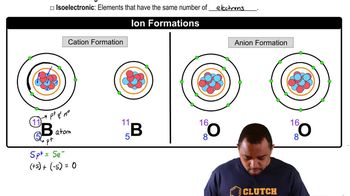
  • What does it mean if two species are isoelectronic?
    Isoelectronic species have the same number of electrons.
  • What is the charge of the chloride ion?
    The charge is -1.
  • What is a cation and an anion?
    A cation is a positively charged ion; an anion is a negatively charged ion.
  • What is the charge on an anion?
    An anion has a negative charge.
  • How does an atom become a cation?
    An atom becomes a cation by losing electrons.
  • What is a cation? Anion?
    A cation is a positively charged ion; an anion is a negatively charged ion.
  • What charge does an atom have before it becomes an ion?
    A neutral atom has no net charge.
  • If an atom of hydrogen gives up one electron, what does it become?
    It becomes a hydrogen ion (H+).
  • What is a cation?
    A cation is a positively charged ion.
  • Why do group 1 atoms most often exist as ions with a +1 charge?
    Group 1 atoms lose one electron to achieve a stable configuration, resulting in a +1 charge.