Ions quiz #7 Flashcards

Ions quiz #7
Control buttons has been changed to "navigation" mode.
1/40
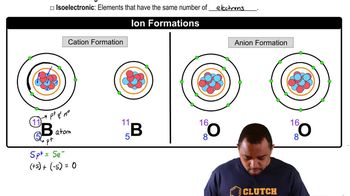
  • When a neutral atom gains one or more electrons, what does it become?
    It becomes a negatively charged ion (anion).
  • What charge did the sodium ions always have when in a salt compound?
    Sodium ions always have a +1 charge.
  • What charge did the chloride ions always have when in a salt compound?
    Chloride ions always have a -1 charge.
  • Which of the following compounds consist of ions?
    Ionic compounds, such as NaCl, consist of ions.
  • Which of the following ions would be colored in solution?
    Transition metal ions, such as Cu2+, are often colored in solution.
  • What element is used to dope an n-type semiconductor?
    Phosphorus is commonly used to dope n-type semiconductors.
  • What type of element is most likely to form an anion?
    Nonmetals are most likely to form anions.
  • What is the most stable monatomic ion formed from nitrogen?
    N3- is the most stable monatomic ion of nitrogen.
  • If an element loses an electron and becomes a cation, what happens to its charge?
    Its charge becomes positive.
  • Does the formation of a cation involve gain of electrons or loss of electrons?
    Formation of a cation involves loss of electrons.
  • Which of the following would be a negative ion with a single charge?
    Cl- is a negative ion with a single charge.
  • The total oxide ion charge in a formula unit of CoO is 2-. What is the charge on each cobalt ion?
    Each cobalt ion has a +2 charge.
  • What are the ions in sodium chloride?
    Na+ and Cl- are the ions in sodium chloride.
  • What is the correct formula for a potassium ion with 18 electrons?
    K+ has 18 electrons.
  • Which ion does not have a noble gas configuration in its ground state?
    Transition metal ions often do not have noble gas configurations.
  • The total oxide ion charge in a formula unit of MnO is 2-. What is the charge on each manganese ion?
    Each manganese ion has a +2 charge.
  • Which atom has the same number of electrons as a P3- ion?
    Argon (Ar) has the same number of electrons as P3-.
  • Which of the following ions will act as a weak base in water?
    The hydroxide ion (OH-) acts as a weak base.
  • What type of atoms form negative ions?
    Nonmetal atoms form negative ions (anions).
  • How many electrons does the atom need in its shell to be stable?
    Most atoms need 8 electrons in their valence shell to be stable (octet rule).
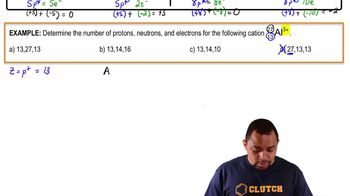
  • What is the ionic charge of an ion with 13 protons and 10 electrons?
    The charge is +3.
  • What is the name of a positive ion?
    A positive ion is called a cation.
  • What is the charge on the ion formed by Na?
    Na forms a +1 ion.
  • When metals lose electrons and become cations, what happens to their charge?
    Their charge becomes positive.
  • Since Na is now positively charged, what is it called?
    It is called a sodium cation (Na+).
  • What happens when potassium forms an ion?
    Potassium loses one electron to form K+.
  • Which term describes a negative ion?
    A negative ion is called an anion.
  • How many electrons would be in a -2 charged anion of sulfur?
    S2- has 18 electrons.
  • How many electrons does O2- have?
    O2- has 10 electrons.
  • How are positive ions formed?
    Positive ions are formed by losing electrons.
  • Which of the following happens when chlorine forms an ion?
    Chlorine gains one electron to form Cl-.
  • When chlorine gains an electron, does it have a more positive or negative charge?
    It has a more negative charge.
  • Which two particles have opposite charges?
    Protons and electrons have opposite charges.
  • Which ion would bond with a calcium ion (Ca2+) to form a neutral ionic compound?
    An ion with a -2 charge, such as SO4^2-, would bond with Ca2+.
  • An ion has 26 protons. What is its identity?
    It is an iron ion (Fe).
  • What charge do cations have?
    Cations have a positive charge.
  • Which ion is a cation?
    Na+ is a cation.
  • An atom has 26 protons and 24 electrons. What is its charge?
    It has a +2 charge.
  • What is the ratio of sodium to chloride ions in NaCl?
    The ratio is 1:1.
  • What is the charge on the Cr in the ionic compound Cr2O3?
    Each Cr ion has a +3 charge.