Limiting Reagent quiz #1 Flashcards

Limiting Reagent quiz #1
Control buttons has been changed to "navigation" mode.
1/11
  • What statements are always true about limiting reactants in a chemical reaction?

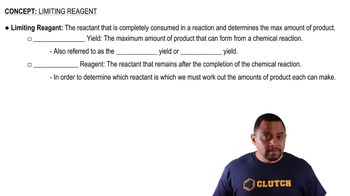
    The limiting reactant is completely consumed first, determines the maximum amount of product (theoretical yield), and controls when the reaction stops.
  • How do you determine which reactant is the limiting reactant in a chemical reaction?

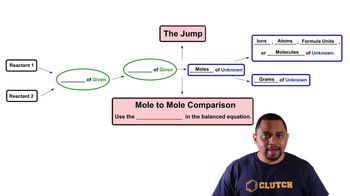
    Calculate the amount of product each reactant can produce using stoichiometry; the reactant that produces the least amount of product is the limiting reactant.
  • Which reactant is used up and stops a chemical reaction?

    The limiting reactant is used up first and stops the chemical reaction.
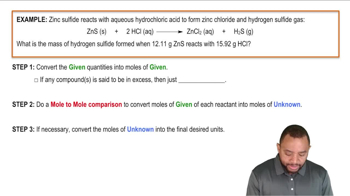
  • What is the limiting reactant if 4.0 g of NH3 react with 8.0 g of O2?

    Convert both masses to moles, use the balanced equation to find the product each can form, and the reactant that produces less product is the limiting reactant.
  • Which of the following is true of a limiting reagent in a chemical reaction?

    The limiting reagent is completely consumed and determines the maximum amount of product formed.
  • Which of the following is true about limiting and excess reagents in a chemical reaction?

    The limiting reagent is used up first and determines the theoretical yield, while the excess reagent remains after the reaction is complete.
  • Which reactant controls the amount of product formed in a chemical reaction?

    The limiting reactant controls the amount of product formed.
  • If 8 g CaCO3 are combined with 4 g of HCl, which is the limiting reactant?

    Convert both masses to moles, use the balanced equation to find the product each can form, and the reactant that produces less product is the limiting reactant.
  • If 1.0 g P4O10 combines with 2.0 g PCl5, which is the limiting reactant?

    Convert both masses to moles, use the balanced equation to find the product each can form, and the reactant that produces less product is the limiting reactant.
  • Which is the limiting reactant when 2.00 g of Si and 1.50 g of N2 react?

    Convert both masses to moles, use the balanced equation to find the product each can form, and the reactant that produces less product is the limiting reactant.
  • What are limiting factors in the context of chemical reactions?

    Limiting factors are reactants that are completely consumed first and determine the maximum amount of product that can be formed.