Back

Molarity quiz

Control buttons has been changed to "navigation" mode.
1/10
  • How is concentration defined in terms of solute and solution volume?

    A) The amount of solute in a given volume of solution.
  • How many molecules of glucose are in 1 L of a 100 mM glucose solution?

    There are approximately 6.022 x 10^22 molecules of glucose in 1 L of a 100 mM glucose solution.
  • What does the molarity of a solution indicate?

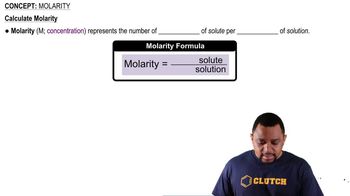
    Molarity indicates the number of moles of solute per liter of solution.
  • What is the formula for calculating molarity?

    The formula for calculating molarity is M = moles of solute / liters of solution.
  • How can molarity be used in chemical calculations?

    Molarity can be used as a conversion factor to convert between moles of solute and volume of solution.
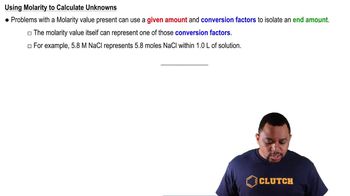
  • What does a 5.8 M sodium chloride solution mean?

    A 5.8 M sodium chloride solution contains 5.8 moles of NaCl in one liter of solution.
  • Why is molarity considered a conversion factor?

    Molarity is considered a conversion factor because it connects two different units: moles of solute and liters of solution.
  • What is the relationship between molarity and concentration?

    Molarity is a specific measure of concentration, representing moles of solute per liter of solution.
  • How does molarity help in determining unknown quantities in a solution?

    Molarity helps in determining unknown quantities by allowing conversion between moles of solute and volume of solution.
  • What is the significance of using molarity in dimensional analysis?

    Using molarity in dimensional analysis allows for the incorporation of concentration as a conversion factor in calculations.