Mole Concept quiz #10 Flashcards

Mole Concept quiz #10
Control buttons has been changed to "navigation" mode.
1/10
  • How many moles of pyridine (C5H5N) are contained in 3.13 g of pyridine?

    3.13 g ÷ 79.10 g/mol ≈ 0.0396 moles.
  • How many atoms are in 14 moles of cadmium?

    14 × 6.022×10^23 = 8.43×10^24 atoms.
  • How many moles are in 15 grams of lithium?

    15 g ÷ 6.94 g/mol ≈ 2.16 moles.
  • How many moles are in 22 grams of argon?

    22 g ÷ 39.95 g/mol ≈ 0.551 moles.
  • Which statement best describes a mole?

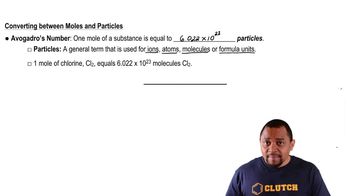
    A mole is a counting unit equal to 6.022×10^23 particles.
  • The number of carbon atoms in exactly 12 g of pure carbon-12 is called a

    Mole (Avogadro's number).
  • What is the difference between an atom and an ion?

    An atom is a single element with no charge, while an ion is a single element that possesses a positive or negative charge.
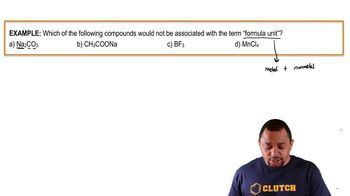
  • Why is the term 'molecules' used when referring to chlorine gas (Cl2) instead of 'atoms' or 'formula units'?

    The term 'molecules' is used because Cl2 consists of two nonmetals bonded together; 'atoms' would refer to single chlorine atoms, and 'formula units' are used for compounds with metals and nonmetals.
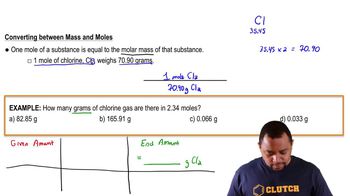
  • How is the molar mass of chlorine gas (Cl2) calculated using the periodic table?

    The molar mass of Cl2 is found by multiplying the atomic mass of chlorine (35.45 g/mol) by 2, resulting in 70.90 g/mol.
  • What general term can be used to refer collectively to atoms, ions, molecules, and formula units when discussing the mole concept?

    The term 'particles' is used to collectively refer to atoms, ions, molecules, and formula units in the context of the mole concept.