Back

Naming Ionic Compounds quiz

Control buttons has been changed to "navigation" mode.
1/15
  • What are the two main components of an ionic compound?

    An ionic compound consists of a positive ion (cation) and a negative ion (anion).
  • How can you remember that cations are positive?

    The 't' in cation resembles a plus sign, indicating a positive charge.
  • What types of ions can serve as cations in ionic compounds?

    Cations can be metals with a positive charge or the ammonium ion (NH4+).
  • What is the only common polyatomic cation besides metals?

    The ammonium ion (NH4+) is the only common polyatomic cation.
  • What types of ions can serve as anions in ionic compounds?

    Anions are typically nonmetals or polyatomic ions with a negative charge.
  • When naming an ionic compound, which ion is named first?

    The cation is always named first in an ionic compound.
  • How is the name of a metal cation determined in an ionic compound?

    The metal cation keeps its elemental name and is written first.
  • When do you use a Roman numeral in naming a metal cation?

    A Roman numeral is used if the metal cation can have multiple charges, such as transition metals.
  • Do main group metals require Roman numerals when naming ionic compounds?

    No, main group metals usually have only one charge and do not require Roman numerals.
  • How is the name of a nonmetal anion formed in an ionic compound?

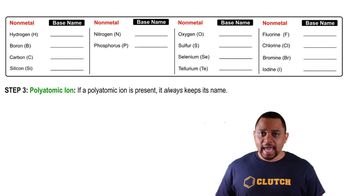
    The nonmetal anion keeps its base name but changes its ending to 'ide'.
  • What is the base name of the nonmetal 'carbon'?

    The base name for carbon is 'carb'.
  • What happens to the name of a polyatomic anion in an ionic compound?

    A polyatomic anion keeps its given name, such as 'phosphate' or 'nitrate'.
  • What is the base name for the nonmetal 'oxygen'?

    The base name for oxygen is 'ox'.
  • What is the suffix added to the base name of a nonmetal when naming its anion?

    The suffix 'ide' is added to the base name of a nonmetal when naming its anion.
  • Why is understanding the nomenclature of ionic compounds important?

    Correct nomenclature is crucial for identifying and communicating about chemical substances.