Nature of Energy quiz #2 Flashcards

Nature of Energy quiz #2
Control buttons has been changed to "navigation" mode.
1/40
  • What is an example of low-quality energy?
    Heat dispersed in the environment is an example of low-quality energy.
  • What does lower potential energy do to a system?
    Lower potential energy makes a system more stable.
  • Why do you feel warm when you workout?
    Muscle activity converts chemical energy in food to thermal energy, raising body temperature.
  • What kind of energy is represented by the change in enthalpy?
    Change in enthalpy represents thermal energy (heat) exchanged at constant pressure.
  • What will happen to a liquid if it is heated?
    Heating a liquid increases particle motion, raising temperature and possibly causing evaporation or boiling.
  • How many joules are there in a 255 calorie snack bar?
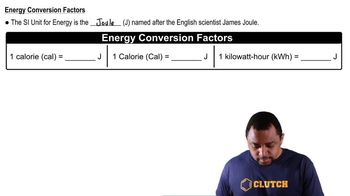
    255 calories × 4.184 J/cal = 1,067 J.
  • How can energy change during a chemical reaction?
    Energy can be absorbed or released as heat, light, or work during a chemical reaction.
  • What is the value of 116 calories in joules (J)?
    116 calories × 4.184 J/cal = 485 J.
  • What is the standard measurement for energy?
    The standard measurement for energy is the joule (J).
  • Gasoline is what form of energy?
    Gasoline contains chemical energy.
  • What is released or absorbed whenever chemical bonds form or are broken?
    Energy is released or absorbed when chemical bonds form or break.
  • Which kind of energy is stored in a chemical bond?
    Chemical energy is stored in chemical bonds.
  • What will happen if you keep increasing the temperature (adding heat) of a liquid?
    The liquid will eventually boil and turn into a gas.
  • Which state of matter has the greatest amount of kinetic energy?
    Gases have the greatest amount of kinetic energy.
  • What happens when you apply heat energy to a substance?
    Applying heat increases particle motion, raising temperature and possibly changing state.
  • Which action represents a conversion of chemical energy into mechanical energy?
    Muscle contraction converts chemical energy from food into mechanical energy.
  • What happens to atoms when you add heat to them?
    Atoms move faster as their kinetic energy increases.
  • What happens to energy when light is transmitted through or reflected off a material?
    Some energy may be absorbed, transmitted, or reflected, depending on the material.
  • What is the term for the amount of energy that needs to be added for a chemical reaction to start?
    Activation energy is the energy needed to start a reaction.
  • What happens to the molecules of a substance when it is heated?
    Molecules move faster and may change state as they gain kinetic energy.
  • What is the source of the thermal energy that heats our planet’s atmosphere?
    The sun is the source of thermal energy for Earth's atmosphere.
  • What sort of energy change is occurring when a block of ice melts?
    Thermal energy is absorbed, causing the ice to melt.
  • What happens to the temperature of a liquid as it evaporates?
    The temperature of the remaining liquid decreases as evaporation occurs.
  • What type of energy is required from the sun for evaporation to occur?
    Thermal energy from the sun is required for evaporation.
  • What happens to the particles in matter when it is heated up?
    Particles move faster and may change state as they gain energy.
  • Why can water evaporate without boiling?
    Some surface molecules have enough energy to escape as vapor even below boiling point.
  • What happens to atoms when they are heated?
    Atoms move more rapidly as their kinetic energy increases.
  • What type of energy is lost when water condenses?
    Thermal energy is released when water condenses.
  • What type of energy is primarily associated with the random motion of the particles in a substance?
    Thermal energy is associated with random particle motion.
  • How does heat energy from the sun reach the earth?
    Heat energy from the sun reaches Earth by radiation.
  • What happens to the molecules when heat is added?
    Molecules move faster and may change state.
  • What is the temperature of the sun’s core?
    The sun’s core temperature is about 15 million degrees Celsius.
  • In which situation is chemical energy being converted to another form of energy?
    Burning fuel converts chemical energy to thermal and light energy.
  • What type of energy is thermal energy?
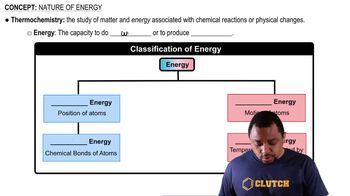
    Thermal energy is a form of kinetic energy.
  • What will happen as an object receives energy due to heat flow?
    The object's temperature will increase and its particles will move faster.
  • What does thermal energy refer to?
    Thermal energy is the total kinetic energy of particles in a substance.
  • Why do particles speed up when heat is added?
    Heat increases kinetic energy, causing particles to move faster.
  • What is the process by which heat energy gets to earth from the sun?
    Radiation is the process by which heat energy reaches Earth from the sun.
  • Chemical energy can be converted into mechanical energy through which system?
    Muscles and engines convert chemical energy into mechanical energy.
  • What is the symbol for thermal energy?
    Thermal energy is often represented by the symbol 'q'.