Nature of Energy quiz #4 Flashcards

Nature of Energy quiz #4
Control buttons has been changed to "navigation" mode.
1/14
  • Clouds, fog, or dew will always form when
    Water vapor loses thermal energy and condenses.
  • Heat always moves from
    Heat always moves from warmer objects to cooler objects.
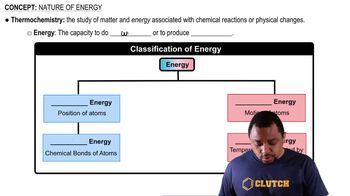
  • Define energy vocabulary.
    Energy: capacity to do work; potential energy: stored energy; kinetic energy: energy of motion; chemical energy: energy in bonds; thermal energy: energy from particle motion.
  • The energy that warms Earth's surface comes primarily in the form of __________.
    Electromagnetic radiation from the sun.
  • The energy for an endergonic reaction comes from a(n) _____ reaction.
    Exergonic reaction provides energy for an endergonic reaction.
  • Chemical energy is a form of _____ energy.
    Chemical energy is a form of potential energy.
  • Earth takes in thermal energy from the sun in a process called
    Earth takes in thermal energy by radiation.
  • All matter has thermal energy because atoms are constantly
    Atoms are constantly in motion, giving all matter thermal energy.
  • Describe how adding thermal energy affects particle motion, temperature, and state.
    Adding thermal energy increases particle motion, raises temperature, and can change the state of matter.
  • Estimate the energy density of butter (in joule/kg).
    Butter has an energy density of about 30,000,000 J/kg.
  • Estimate the energy in a pound of butter (in joule).
    A pound (0.454 kg) of butter contains about 13,600,000 J.
  • What type of energy is stored in a battery?
    A battery stores chemical energy.
  • The energy needed to destabilize existing chemical bonds and start a chemical reaction is called
    Activation energy.
  • Estimate the energy (in joule) contained in a quart of soda.
    A quart (about 1 kg) of soda contains roughly 1,500,000 J.