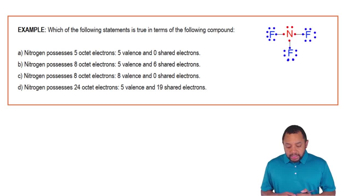
The atomic structure of water satisfies the octet rule by having:
The atomic structure of water satisfies the octet rule by having 8 electrons around both the oxygen and hydrogen atoms (hydrogen achieves 2, oxygen achieves 8).
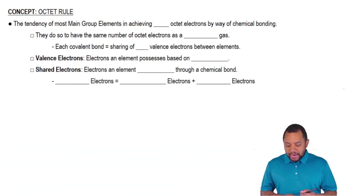
What is the main reason most elements follow the octet rule?
Most elements follow the octet rule to achieve the same stable electron configuration as noble gases, which have eight electrons in their valence shell.
How is the number of valence electrons for an element determined?
The number of valence electrons is determined by the element's group number in the periodic table.
What is the relationship between covalent bonds and valence electrons in the context of the octet rule?
Each covalent bond represents the sharing of two valence electrons between atoms, helping them achieve a stable octet.
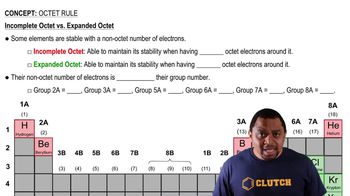
Which elements commonly have an incomplete octet and remain stable?
Hydrogen, helium, beryllium, and some Group 3A elements like boron, aluminum, gallium, and indium commonly have incomplete octets and are stable.
What is meant by an expanded octet, and which elements can have one?
An expanded octet refers to elements that can have more than eight electrons in their valence shell, typically found in period 3 and below, such as phosphorus, sulfur, and chlorine.
Why are noble gases generally unreactive in terms of chemical bonding?
Noble gases are generally unreactive because they already possess a complete and stable octet, making them less likely to form chemical bonds.
How do shared electrons contribute to an atom's octet electron count?
Shared electrons gained through chemical bonds are added to an atom's valence electrons to help reach a total of eight octet electrons.
For elements with a non-octet number of electrons, how is their stable electron count typically calculated?
For these elements, their stable electron count is typically twice their group number.
Which period in the periodic table allows elements to have expanded octets, and why?
Elements in period 3 and below can have expanded octets because their larger electron shells can accommodate more than eight electrons.