Periodic Table: Classifications quiz #5 Flashcards

Periodic Table: Classifications quiz #5
Control buttons has been changed to "navigation" mode.
1/40
  • Who arranged the periodic table in order of increasing atomic number?
    Henry Moseley.
  • How are the elements arranged?
    By increasing atomic number.
  • Metals are located where on the periodic table?
    On the left and center.
  • Which of the following would be classified as a metalloid?
    Silicon (Si) would be classified as a metalloid.
  • Which element is considered a metalloid?
    Arsenic (As) is considered a metalloid.
  • In what order did Mendeleev arrange the elements in the periodic table?
    By increasing atomic mass.
  • What are the rows of the periodic table of elements called?
    Periods.
  • How are elements on the periodic table arranged?
    By increasing atomic number.
  • How did Mendeleev group the elements?
    By similar chemical properties and increasing atomic mass.
  • What does the table organize the elements by?
    By atomic number and chemical properties.
  • Which of the following is a metal?
    Iron (Fe) is a metal.
  • Which of the elements listed is a metalloid?
    Germanium (Ge) is a metalloid.
  • How is the periodic table arranged today?
    By increasing atomic number.
  • Which set of elements contains a metalloid?
    A set containing boron (B) contains a metalloid.
  • How are the elements ordered on the periodic table?
    By increasing atomic number.
  • How are elements ordered on the periodic table?
    By increasing atomic number.
  • How is the periodic table structured with regard to elements with similar properties?
    Elements with similar properties are grouped in columns (groups).
  • How did Mendeleev organize the elements in his periodic table?
    By increasing atomic mass and grouping similar elements.
  • Which of the following is not a metalloid?
    Phosphorus (P) is not a metalloid.
  • What is an example of a metalloid?
    Silicon (Si) is an example of a metalloid.
  • Who arranged the periodic table by the atomic mass?
    Dmitri Mendeleev.
  • How many metalloids are on the periodic table?
    There are 7 metalloids on the periodic table.
  • Who arranged the elements into the first periodic table?
    Dmitri Mendeleev.
  • What property did Mendeleev use to organize his periodic table?
    Increasing atomic mass.
  • Which of the following does not describe a metal?
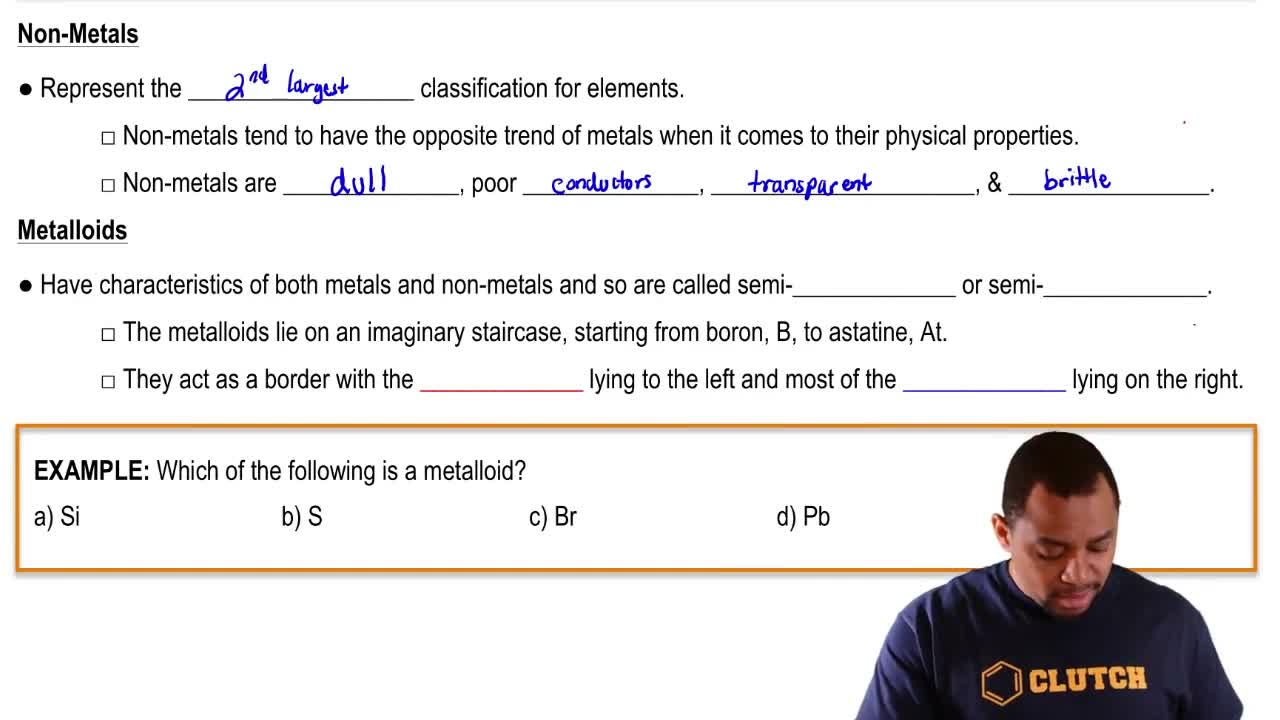
    Being brittle does not describe a metal.
  • How is the periodic table of the elements organized?
    By increasing atomic number and similar properties.
  • What property did Mendeleev use to organize the elements into a periodic table?
    Atomic mass.
  • Which characteristic belongs to metalloids?
    Metalloids have properties of both metals and nonmetals.
  • Elements organized by columns
    Elements in columns are called groups or families and have similar properties.
  • How many metalloids are there on the periodic table?
    There are 7 metalloids.
  • Which is an example of a metalloid?
    Arsenic (As) is an example of a metalloid.
  • Who arranged the periodic table by atomic number?
    Henry Moseley.
  • Which list of elements consists of metalloids?
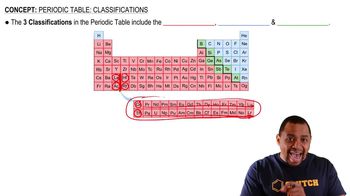
    Boron, silicon, germanium, arsenic, antimony, tellurium, and astatine.
  • Which scientist organized the known elements into the periodic table?
    Dmitri Mendeleev.
  • How is the current periodic table organized?
    By increasing atomic number.
  • What are the left to right rows on the periodic table called?
    Periods.
  • What do we call the arrangement of elements with similar properties?
    A group or family.
  • What category of elements is found between the metals and nonmetals on the periodic table?
    Metalloids.
  • Which group of elements belongs to the f-block?
    The lanthanides and actinides belong to the f-block.
  • How are the elements on periodic table arranged?
    By increasing atomic number.