Periodic Table: Classifications quiz #6 Flashcards

Periodic Table: Classifications quiz #6
Control buttons has been changed to "navigation" mode.
1/40
  • Which of the following is the most specific classification for the element europium?
    Europium is a lanthanide.
  • In the modern periodic table, how are elements arranged?
    By increasing atomic number.
  • Is magnesium a metal or a nonmetal?
    Magnesium is a metal.
  • What do we call rows in the periodic table?
    Periods.
  • Which properties are most common in nonmetals?
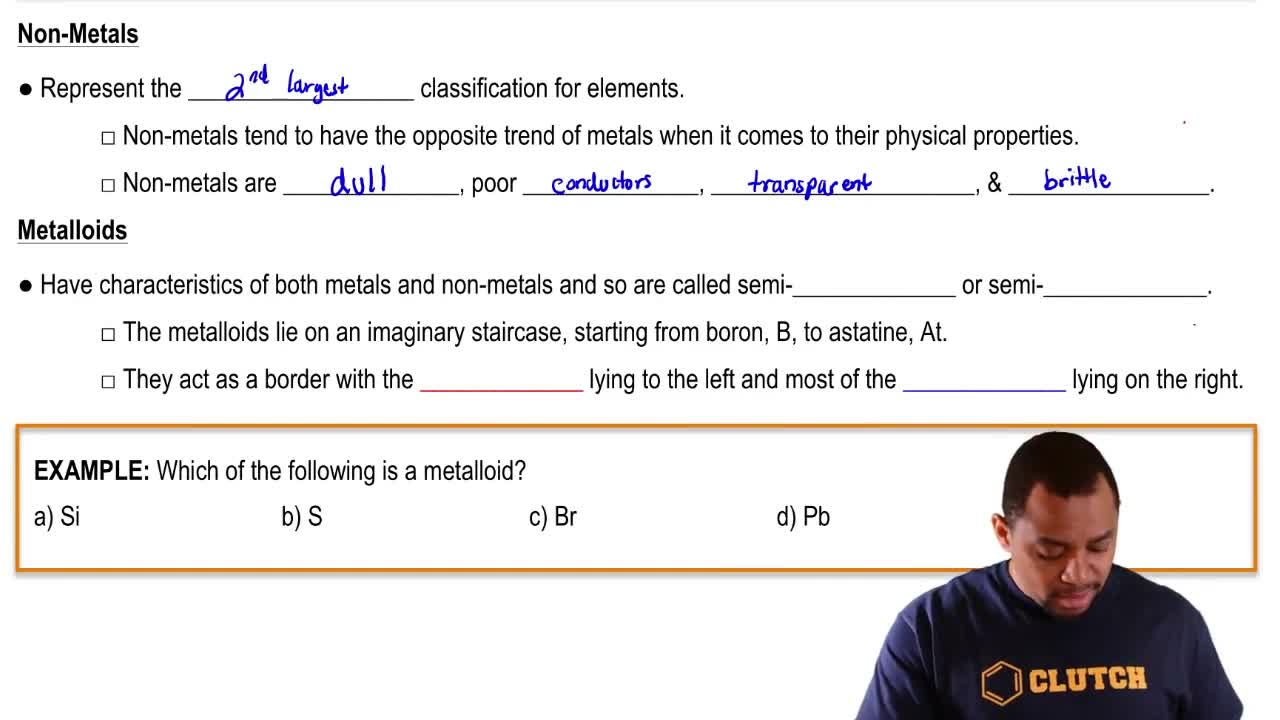
    Nonmetals are dull, poor conductors, and brittle.
  • Which scientist created the periodic table and arranged elements in increasing atomic mass?
    Dmitri Mendeleev.
  • What are the examples of metalloids?
    Boron, silicon, germanium, arsenic, antimony, tellurium, and astatine.
  • Which is not a family of the periodic table?
    Metalloids are not a family; they are a classification.
  • Is hydrogen a metal or a nonmetal?
    Hydrogen is a nonmetal.
  • What property did Mendeleev use to develop and organize his periodic table?
    Atomic mass.
  • Which of the elements are metalloids?
    Boron, silicon, germanium, arsenic, antimony, tellurium, and astatine.
  • Which element group represents elements that are metalloids?
    Elements along the staircase from boron to astatine are metalloids.
  • Do metalloids contain properties of both metals and nonmetals?
    Yes, metalloids have properties of both metals and nonmetals.
  • Who developed the original periodic table which listed elements by increasing atomic mass?
    Dmitri Mendeleev.
  • Rows of the periodic table are called?
    Periods.
  • Who reorganized the elements on the periodic table by increasing atomic number?
    Henry Moseley.
  • Which statement describes the location of metalloids on the periodic table?
    Metalloids are located along the staircase between metals and nonmetals.
  • Which elements are in the same period?
    Elements in the same horizontal row are in the same period.
  • Which characteristic of an element determines its placement in the periodic table?
    Atomic number.
  • What are the rows in the periodic table called?
    Periods.
  • What are the horizontal rows in the periodic table called?
    Periods.
  • Dmitri Mendeleev was the first known scientist to order elements into a table?
    Yes, Mendeleev was the first to organize elements into a periodic table.
  • Which lists only metalloids?
    Boron, silicon, germanium, arsenic, antimony, tellurium, and astatine.
  • Which properties do metalloids share with metals?
    Metalloids can conduct electricity like metals.
  • Which elements are metalloids? Check all that apply.
    Boron, silicon, germanium, arsenic, antimony, tellurium, and astatine.
  • What is the difference between a period and a group on the periodic table of elements?
    A period is a horizontal row; a group is a vertical column.
  • What is the significance of the periodic table of elements? Choose the best answer.
    It organizes elements by their properties, making chemical behavior predictable.
  • In which set of elements would all members be expected to have very similar chemical properties?
    Elements in the same group (vertical column) have similar properties.
  • Consider the fourth period elements Ca. What is its classification?
    Calcium (Ca) is a metal.
  • Which element is likely to be the most brittle: selenium, cobalt, platinum, or zinc?
    Selenium is likely to be the most brittle.
  • Which metalloids would behave more like metals? Which metalloids would behave more like nonmetals?
    Metalloids closer to metals (like antimony) behave more like metals; those closer to nonmetals (like boron) behave more like nonmetals.
  • Where are the most reactive nonmetal elements found on the periodic table?
    The most reactive nonmetals are found in Group 17 (halogens) on the right side.
  • Which elements have similar behavior: barium, silicon, aluminum, strontium, osmium, beryllium?
    Barium and strontium have similar behavior; both are alkaline earth metals.
  • Which element is magnetic: calcium, chromium, carbon, or cobalt?
    Cobalt is magnetic.
  • Who created the periodic table?
    Dmitri Mendeleev.
  • Which two elements have similar characteristics?
    Elements in the same group, such as sodium and potassium, have similar characteristics.
  • Which statements accurately describe trends found in the periodic table? Check all that apply.
    Elements in the same group have similar properties; metals are on the left, nonmetals on the right; atomic number increases left to right.
  • Which of these grouping of elements could have the characteristic of luster (shiny)?
    Metals have the characteristic of luster.
  • Which significantly helped chemists organize the many facts associated with the elements?
    The periodic table helped organize facts about elements.
  • Which of these best shows that calcium is different from all other elements?
    Calcium has a unique atomic number.