Periodic Table: Elemental Forms quiz #1 Flashcards

Periodic Table: Elemental Forms quiz #1
Control buttons has been changed to "navigation" mode.
1/35
  • Which of the following molecular models represents an element?
    A molecular model that contains only one type of atom, such as O2, H2, or S8, represents an element.
  • Which of the following is the most abundant gas by volume in the atmosphere?
    Nitrogen (N2) is the most abundant gas by volume in the atmosphere.
  • Which of the following elements does not exist as a diatomic molecule?
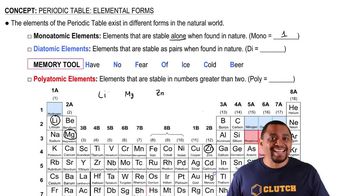
    Elements like magnesium (Mg) do not exist as diatomic molecules; they are monoatomic in their natural state.
  • Which of these elements does not exist as a diatomic molecule?
    Elements such as zinc (Zn) do not exist as diatomic molecules in nature.
  • Which elements are diatomic?
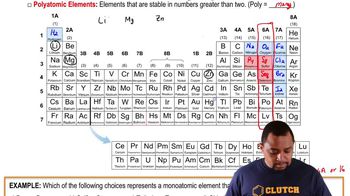
    The diatomic elements are hydrogen (H2), nitrogen (N2), oxygen (O2), fluorine (F2), chlorine (Cl2), bromine (Br2), and iodine (I2).
  • What is the rarest naturally occurring element on earth?
    Astatine is considered the rarest naturally occurring element on earth.
  • Which among the following elements does not exist as a diatomic molecule in nature?
    Elements such as lithium (Li) do not exist as diatomic molecules in nature.
  • What element does not react with other elements?
    Noble gases, such as helium (He), are elements that do not readily react with other elements.
  • Which of the following describes the properties of noble gases?
    Noble gases are monoatomic, chemically inert, and do not readily form compounds.
  • Which of the following elements is not diatomic?
    Elements like sulfur (S) are not diatomic; sulfur exists as S8 in its natural state.
  • Which of the following elements exists as a diatomic molecule?
    Oxygen (O2) exists as a diatomic molecule in its natural state.
  • Which metal has the highest melting point?
    Tungsten (W) is the metal with the highest melting point.
  • Which of the following does not exist as a diatomic molecule?
    Phosphorus (P) does not exist as a diatomic molecule; it exists as P4.
  • Which of the following is not a diatomic element?
    Carbon (C) is not a diatomic element.
  • Why is graphite considered an element?
    Graphite is considered an element because it is a form (allotrope) of pure carbon.
  • Which of the following elements does not occur as a diatomic molecule?
    Neon (Ne) does not occur as a diatomic molecule; it is monoatomic.
  • Which of the following is not a diatomic molecule?
    S8 (sulfur) is not a diatomic molecule; it is polyatomic.
  • Which one of the following elements does not exist as a diatomic molecule in nature?
    Aluminum (Al) does not exist as a diatomic molecule in nature.
  • Which of the following is an allotrope of carbon?
    Graphite is an allotrope of carbon.
  • Which one of the following does not occur as diatomic molecules in elemental form?
    Phosphorus (P) does not occur as diatomic molecules; it exists as P4.
  • Which of the following pairs of substances are allotropes?
    Diamond and graphite are allotropes of carbon.
  • Which of the following formulas represents an element in its natural state?
    O2 represents an element (oxygen) in its natural diatomic state.
  • Which of the following elements occurs naturally as diatomic molecules?
    Chlorine (Cl2) occurs naturally as a diatomic molecule.
  • How many elements are found in nature?
    There are about 90 elements that have been found to occur naturally.
  • How many elements have been found to occur in nature?
    Approximately 90 elements have been found to occur in nature.
  • Where is the lanthanide series located?
    The lanthanide series is located in the f-block of the periodic table, typically shown below the main table.
  • Nitrogen exists in what form in the atmosphere?
    Nitrogen exists as N2 (a diatomic molecule) in the atmosphere.
  • What element is the most abundant in Earth's crust by weight?
    Oxygen is the most abundant element in Earth's crust by weight.
  • Are all the elements in today’s periodic table naturally occurring?
    No, not all elements in the periodic table are naturally occurring; some are synthetic.
  • Which element is most likely to be shiny? Sulfur (S), Boron (B), Calcium (Ca), or Fluorine (F)?
    Calcium (Ca) is most likely to be shiny because it is a metal.
  • Which element is magnetic?
    Iron (Fe) is an element that is magnetic.
  • An example of an elemental molecule is
    O2 (oxygen gas) is an example of an elemental molecule.
  • Copper is an example of
    Copper is an example of a monoatomic element in its natural state.
  • I am the only element in the halide family that is a liquid.
    Bromine (Br2) is the only halogen that is a liquid at room temperature.
  • The only nonmetal that is a liquid at room temperature is
    Bromine (Br2) is the only nonmetal that is a liquid at room temperature.