Periodic Table: Group Names quiz #2 Flashcards

Periodic Table: Group Names quiz #2
Control buttons has been changed to "navigation" mode.
1/40
  • What group of elements have a naturally full outer shell of electrons?
    Noble gases (Group 18) have a naturally full outer shell of electrons.
  • Which set of elements have chemical properties similar to those of phosphorus?
    Nitrogen (N), arsenic (As), and antimony (Sb) have chemical properties similar to phosphorus because they are in Group 15.
  • Which list consists of elements that have the most similar chemical properties?
    Fluorine (F), chlorine (Cl), bromine (Br), and iodine (I) have the most similar chemical properties as halogens.
  • Which group of elements on the periodic table is unreactive?
    Group 18, the noble gases, is unreactive.
  • How are elements similar to those in the same group on the periodic table?
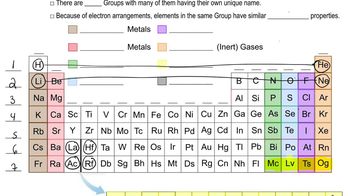
    Elements in the same group have similar chemical properties due to similar electron arrangements.
  • Which element has similar chemical properties to O?
    Sulfur (S) has similar chemical properties to oxygen because both are chalcogens in Group 16.
  • Which pair of elements has the most similar properties?
    Sodium (Na) and potassium (K) have the most similar properties as alkali metals.
  • Which elements have the most similar properties?
    Elements in the same group, such as chlorine (Cl) and bromine (Br), have the most similar properties.
  • Which element would have similar properties to sulfur?
    Oxygen (O) would have similar properties to sulfur.
  • Where are the most active nonmetals located?
    The most active nonmetals are located in Group 17, the halogens, on the right side of the periodic table.
  • Which of the following elements would be chemically similar to selenium (Se)?
    Tellurium (Te) would be chemically similar to selenium because both are in Group 16.
  • Which element is more reactive than rubidium (Rb)?
    Cesium (Cs) is more reactive than rubidium because it is lower in Group 1.
  • Which group on the periodic table is the most reactive?
    Group 1, the alkali metals, is the most reactive group.
  • Which group of elements are extremely reactive because they contain only one valence electron?
    Alkali metals (Group 1) are extremely reactive because they have one valence electron.
  • Which element is classified as a halogen?
    Chlorine (Cl) is classified as a halogen.
  • Which element will have properties most similar to those of potassium?
    Sodium (Na) will have properties most similar to potassium.
  • Which of the following elements would be the most reactive?
    Sodium (Na) would be the most reactive among the options if compared to nickel, carbon, and oxygen.
  • Where are the noble gases located on the periodic table?
    Noble gases are located in Group 18, the far right column of the periodic table.
  • Which region contains elements with two valence electrons?
    Group 2, the alkaline earth metals, contains elements with two valence electrons.
  • What group is fluorine in?
    Fluorine is in Group 17.
  • Which group of elements in the periodic table contains the noble gases?
    Group 18 contains the noble gases.
  • Which group on the periodic table contains elements that are the least reactive?
    Group 18, the noble gases, contains the least reactive elements.
  • Strontium (Sr) shares common properties with what other element?
    Strontium shares common properties with calcium (Ca) because both are in Group 2.
  • Who is credited with arranging the periodic table?
    Dmitri Mendeleev is credited with arranging the periodic table.
  • What principle did Mendeleev use to place elements into groups in his periodic table?
    Mendeleev placed elements into groups based on similar chemical properties and atomic mass.
  • Which elements have similar chemical properties?
    Elements in the same group, such as sodium (Na) and potassium (K), have similar chemical properties.
  • Which of the following is the same for both hydrogen and potassium?
    Both hydrogen and potassium are in Group 1.
  • Which is the only group 15 element classified as a metal?
    Bismuth (Bi) is the only Group 15 element classified as a metal.
  • Which of these elements is an alkaline earth metal?
    Magnesium (Mg) is an alkaline earth metal.
  • Which of the following elements is a halogen?
    Bromine (Br) is a halogen.
  • What is the most reactive element on the periodic table?
    Francium (Fr) is considered the most reactive element.
  • Which group of elements have properties of metals and nonmetals?
    Metalloids have properties of both metals and nonmetals.
  • Which two elements have chemical properties that are most similar?
    Chlorine (Cl) and bromine (Br) have chemical properties that are most similar.
  • What are the groups in Mendeleev’s table?
    Groups in Mendeleev’s table are vertical columns of elements with similar chemical properties.
  • The columns of the periodic table of elements are sometimes referred to as what?
    Columns are sometimes referred to as groups or families.
  • Which two elements have properties that are the most similar?
    Sodium (Na) and potassium (K) have the most similar properties.
  • Why is the periodic table organized into groups?
    The periodic table is organized into groups to show elements with similar chemical properties.
  • Which element is a member of the halogen family?
    Iodine (I) is a member of the halogen family.
  • How many groups make up the periodic table?
    There are 18 groups in the periodic table.
  • What do we call columns in the periodic table?
    Columns in the periodic table are called groups or families.