Periodic Table: Representative Elements & Transition Metals quiz #1 Flashcards

Periodic Table: Representative Elements & Transition Metals quiz #1
Control buttons has been changed to "navigation" mode.
1/40
  • Which element is classified as an inner transition element?
    An inner transition element is one found in the lanthanide or actinide series, such as Cerium (Ce) or Uranium (U).
  • Which element in period 3 of the periodic table is a metalloid?
    Silicon (Si) is the metalloid in period 3.
  • In which block of the periodic table is chromium (Cr) found: s block, d block, p block, or f block?
    Chromium (Cr) is found in the d block.
  • Which two elements are the most abundant in the Earth's crust?
    Oxygen (O) and silicon (Si) are the most abundant elements in the Earth's crust.
  • Which element has 4 energy levels and 8 valence electrons?
    Krypton (Kr) has 4 energy levels and 8 valence electrons.
  • Which element below has properties of both metals and nonmetals?
    A metalloid, such as silicon (Si), has properties of both metals and nonmetals.
  • Which representative elements have three valence electrons?
    Elements in group 13 (such as boron, aluminum) have three valence electrons.
  • What is the most abundant element in the Earth's crust?
    Oxygen (O) is the most abundant element in the Earth's crust.
  • Which of the following elements is in the same period as phosphorus?
    Sulfur (S), chlorine (Cl), and argon (Ar) are in the same period (period 3) as phosphorus (P).
  • What type of element is found in period 3?
    Period 3 contains metals, metalloids, and nonmetals.
  • Which of the following electron configurations represents a transition metal atom?
    An electron configuration ending in a partially filled d subshell, such as [Ar] 3d5 4s2 (for manganese, Mn), represents a transition metal.
  • What are the two most common elements in Earth's crust?
    Oxygen (O) and silicon (Si) are the two most common elements in Earth's crust.
  • The main group elements exclude which parts of the periodic table?
    Main group elements exclude the transition metals (groups 3 to 12) and inner transition metals.
  • Which metalloid is used in solar cells and computer chips?
    Silicon (Si) is the metalloid used in solar cells and computer chips.
  • Which element has properties of both metals and nonmetals?
    A metalloid, such as silicon (Si), has properties of both metals and nonmetals.
  • Which of the following elements is a transition metal?
    Iron (Fe) is a transition metal.
  • Which of the following elements is most common in the Earth's crust?
    Oxygen (O) is the most common element in the Earth's crust.
  • Which element is found in period 3?
    Elements in period 3 include sodium (Na), magnesium (Mg), aluminum (Al), silicon (Si), phosphorus (P), sulfur (S), chlorine (Cl), and argon (Ar).
  • What element is in period 4?
    Elements in period 4 include potassium (K), calcium (Ca), scandium (Sc), titanium (Ti), vanadium (V), chromium (Cr), manganese (Mn), iron (Fe), cobalt (Co), nickel (Ni), copper (Cu), zinc (Zn), gallium (Ga), germanium (Ge), arsenic (As), selenium (Se), bromine (Br), and krypton (Kr).
  • What are the four most abundant elements in Earth's crust?
    Oxygen (O), silicon (Si), aluminum (Al), and iron (Fe) are the four most abundant elements in Earth's crust.
  • What is the defining characteristic of transition metals?
    Transition metals are characterized by variable oxidation states and partially filled d subshells.
  • Where are the most active metals located on the periodic table?
    The most active metals are located in group 1 (alkali metals) and group 2 (alkaline earth metals) on the left side of the periodic table.
  • Where are the representative elements found on the periodic table?
    Representative elements are found in groups 1, 2, and 13 to 18.
  • Which of the following can be found in the second period of the periodic table?
    Elements in the second period include lithium (Li), beryllium (Be), boron (B), carbon (C), nitrogen (N), oxygen (O), fluorine (F), and neon (Ne).
  • Which three elements are the most common in Earth's crust?
    Oxygen (O), silicon (Si), and aluminum (Al) are the three most common elements in Earth's crust.
  • Which element is the most abundant in Earth's crust?
    Oxygen (O) is the most abundant element in Earth's crust.
  • Which element is an excellent conductor of electricity and is often used in electrical wiring?
    Copper (Cu) is an excellent conductor of electricity and is often used in electrical wiring.
  • What is the most common element in the Earth's crust?
    Oxygen (O) is the most common element in the Earth's crust.
  • Which element has a total of two occupied principal energy levels?
    Elements in period 2, such as carbon (C), have two occupied principal energy levels.
  • What two elements did Pierre and Marie Curie discover?
    Pierre and Marie Curie discovered polonium (Po) and radium (Ra).
  • Which are the two most abundant elements of the Earth's continental crust?
    Oxygen (O) and silicon (Si) are the two most abundant elements in the Earth's continental crust.
  • How many elements are in period 4?
    There are 18 elements in period 4.
  • What are the top three most abundant elements in Earth's continental crust?
    Oxygen (O), silicon (Si), and aluminum (Al) are the top three most abundant elements in Earth's continental crust.
  • Which element in period 3 is known to be a highly reactive metal?
    Sodium (Na) is a highly reactive metal in period 3.
  • Which of the following is a lanthanide element?
    Cerium (Ce) is a lanthanide element.
  • Where are the transition metals found on the periodic table?
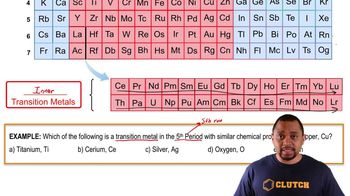
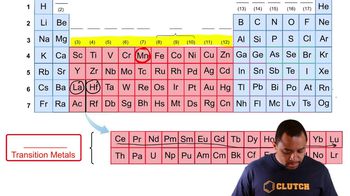
    Transition metals are found in groups 3 to 12, in the center of the periodic table.
  • What three elements make up most of the atmosphere?
    Nitrogen (N), oxygen (O), and argon (Ar) make up most of the atmosphere.
  • What do all of the elements in period 3 have in common?
    All elements in period 3 have three occupied principal energy levels.
  • What is the most abundant metal on Earth?
    Aluminum (Al) is the most abundant metal in Earth's crust.
  • Which of the following is not one of the eight most common elements in Earth's crust?
    Gold (Au) is not one of the eight most common elements in Earth's crust.