Periodic Trend: Electronegativity quiz #1 Flashcards

Periodic Trend: Electronegativity quiz #1
Control buttons has been changed to "navigation" mode.
1/40
  • Which statements accurately describe the polarity and electronegativity of water?

    Water is a polar molecule because oxygen is more electronegative than hydrogen, causing an uneven distribution of electrons.
  • How is electronegativity related to covalent bonding?

    Electronegativity differences between atoms in a covalent bond determine bond polarity; larger differences create more polar bonds.
  • Which is most likely true about electronegativity?

    Electronegativity measures an atom's ability to attract electrons in a chemical bond.
  • Which of the following elements has the lowest electronegativity?

    Francium has the lowest electronegativity.
  • Which element has the highest electronegativity?

    Fluorine has the highest electronegativity.
  • Atoms of which element in group 15 have the greatest electronegativity?

    Nitrogen has the greatest electronegativity in group 15.
  • Which of the following elements has the highest electronegativity?

    Fluorine has the highest electronegativity.
  • Which group in the periodic table tends to have high electronegativity values?

    Group 17 (halogens) tends to have high electronegativity values.
  • Which property determines an atom's ability to attract electrons shared in a chemical bond?

    Electronegativity determines an atom's ability to attract shared electrons.
  • Which one of the following statements best describes electronegativity in atoms?

    Electronegativity is an atom's tendency to attract electrons in a chemical bond.
  • Why does fluorine have a high electronegativity?

    Fluorine has a high electronegativity because it is small and has a high effective nuclear charge.
  • Which element is the most electronegative?

    Fluorine is the most electronegative element.
  • Which best describes the trends in electronegativity on the periodic table?

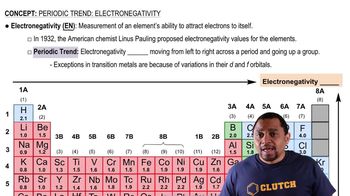
    Electronegativity increases across a period and up a group.
  • What is the electronegativity difference between sodium and chlorine?

    The electronegativity difference between sodium and chlorine is large, leading to ionic bond formation.
  • Which of these elements is the most electronegative?

    Fluorine is the most electronegative.
  • Which one of the following is the least electronegative atom?

    Francium is the least electronegative atom.
  • What is the element with the highest electronegativity value?

    Fluorine has the highest electronegativity value.
  • What determines how reactive an element is?

    Electronegativity and electron configuration determine an element's reactivity.
  • What trend in electronegativity do you see as you go across a period/row on the periodic table?

    Electronegativity increases as you go across a period.
  • Which element has the lowest electronegativity?

    Francium has the lowest electronegativity.
  • What trend in electronegativity do you see as you go down a group/family on the periodic table?

    Electronegativity decreases as you go down a group.
  • Which statement is true about electronegativity?

    Electronegativity increases across a period and decreases down a group.
  • Why can smaller atoms more easily attract electrons?

    Smaller atoms have electrons closer to the nucleus, increasing their ability to attract electrons.
  • Why does fluorine (F) have a high electronegativity?

    Fluorine has a high electronegativity due to its small size and high nuclear charge.
  • Using the Pauling electronegativity scale, which element is the most electronegative?

    Fluorine is the most electronegative on the Pauling scale.
  • Which element has the greatest electronegativity?

    Fluorine has the greatest electronegativity.
  • What is the element with the lowest electronegativity value?

    Francium has the lowest electronegativity value.
  • Which element in the halogens has the highest electronegativity?

    Fluorine has the highest electronegativity among the halogens.
  • Why does electronegativity increase as we go up the periodic table?

    Electronegativity increases up the table because atoms are smaller and attract electrons more strongly.
  • Which of the following elements is the most electronegative?

    Fluorine is the most electronegative.
  • Which of the following will have a higher electronegativity than arsenic (As)?

    Elements to the right and above arsenic, such as oxygen and fluorine, have higher electronegativity.
  • Which of the following elements is the most reactive? Chlorine, bromine, fluorine, helium.

    Fluorine is the most reactive among these elements.
  • What happens to electronegativity across a period?

    Electronegativity increases across a period.
  • Which is the most electronegative halogen?

    Fluorine is the most electronegative halogen.
  • What is the periodic trend for electronegativity?

    Electronegativity increases across a period and up a group.
  • Which of the following elements has the strongest attraction for electrons?

    Fluorine has the strongest attraction for electrons.
  • Which is most reactive: nitrogen or fluorine?

    Fluorine is more reactive than nitrogen.
  • Which of the following options correctly describe electronegativity and its trends?

    Electronegativity increases across a period and decreases down a group.
  • How do the electronegativities of the elements change across a period and down a group?

    Electronegativity increases across a period and decreases down a group.
  • Which element would have the lowest electronegativity?

    Francium would have the lowest electronegativity.