Pearson+ LogoPearson+ Logo

Physical Properties quiz #3 Flashcards

Back
Physical Properties quiz #3
Control buttons has been changed to "navigation" mode.
1/23
  • Which of the following formations is a physical property of copper?

    Copper can be drawn into wires, showing ductility.
  • Which property would be least helpful in determining whether a substance is a metal or a nonmetal?

    Color would be least helpful, as both metals and nonmetals can have similar colors.
  • Why do metals have high melting and boiling points?

    Metals have high melting and boiling points due to strong metallic bonds.
  • Which property is changed between 100 ml of water at 5°C and 100 ml of water at 45°C?

    Temperature is the property that changes.
  • Which statement best describes the molecules in a solid?

    Molecules in a solid are closely packed and vibrate in place.
  • The resistance of a mineral to abrasion is known as ________.

    The resistance of a mineral to abrasion is known as hardness.
  • Wicking is important for exercise clothing because it __________.

    Wicking is important because it helps move moisture away from the skin.
  • Describe the physical qualities and importance of gold.

    Gold is dense, malleable, ductile, and does not tarnish, making it valuable for jewelry and electronics.
  • The strong tendency of certain minerals to break along smooth, parallel planes is known as ________.

    This tendency is known as cleavage.
  • Is ductility a physical or chemical property?

    Ductility is a physical property.
  • What is the boiling point of neon in kelvin?

    The boiling point of neon is about 27 K.
  • Which option is an example of a physical property?

    Melting point is an example of a physical property.
  • What is a physical property in chemistry?

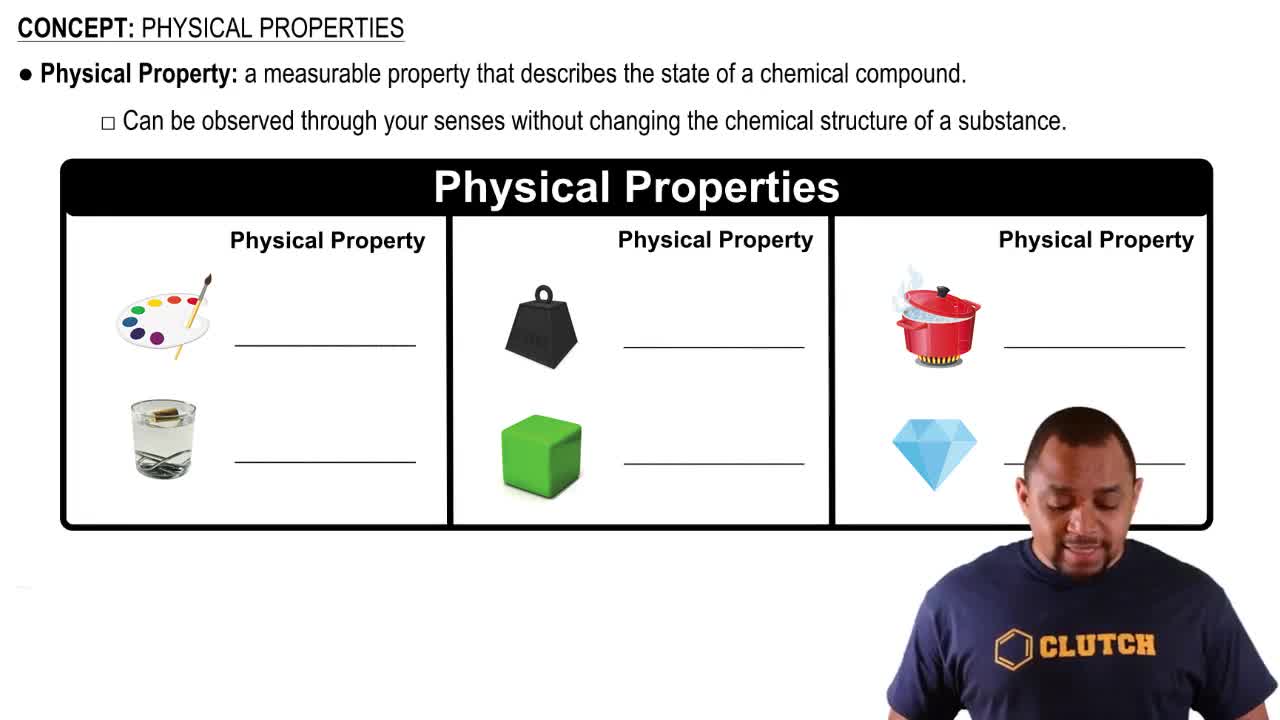
    A physical property is a measurable attribute that describes the state of a chemical compound without altering its chemical structure, such as color, density, mass, volume, boiling point, freezing point, melting point, and hardness.
  • How is boiling point defined as a physical property?

    Boiling point is the temperature at which a substance changes from a liquid to a gas, and it is a physical property because it can be measured without changing the chemical structure of the substance.
  • What is the significance of melting point as a physical property?

    Melting point is the temperature at which a substance changes from solid to liquid, and it helps identify and classify substances without altering their chemical structure.
  • Why is density considered a physical property?

    Density is considered a physical property because it measures how much mass is contained in a given volume and can be observed without changing the substance's chemical composition.
  • How can hardness be used to classify materials?

    Hardness measures a material's resistance to deformation or scratching and is used to classify materials on a scale from soft to hard, such as comparing diamond to other substances.
  • What physical property determines whether an object sinks or floats in water?

    Density determines whether an object sinks or floats in water; objects with higher density than water sink, while those with lower density float.
  • What is the normal boiling point of water?

    The normal boiling point of water is the temperature at which water changes from liquid to gas at standard atmospheric pressure.
  • How can physical properties be observed?

    Physical properties can be observed using our senses, such as seeing color, feeling hardness, or measuring temperature changes like boiling or melting points.
  • What is the difference between mass and volume as physical properties?

    Mass is the amount of matter in an object, while volume is the amount of space the object occupies; both are physical properties that help describe substances.
  • Why is color considered a physical property?

    Color is considered a physical property because it can be observed visually and does not involve changing the chemical structure of the substance.
  • What are some common examples of physical properties used to identify substances?

    Common examples include color, density, mass, volume, boiling point, freezing point, melting point, and hardness.