Back

Polyatomic Ions quiz

Control buttons has been changed to "navigation" mode.
1/15
  • What is a polyatomic ion?

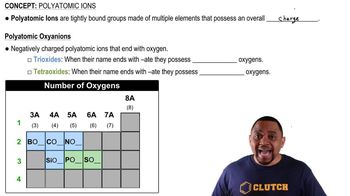
    A polyatomic ion is a tightly bound group of different elements that possesses an overall charge, which can be positive or negative.
  • What are polyatomic oxyanions?

    Polyatomic oxyanions are negatively charged polyatomic ions that contain oxygen.
  • How many oxygens are in trioxides and what is a memory trick for them?

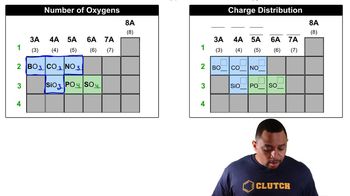
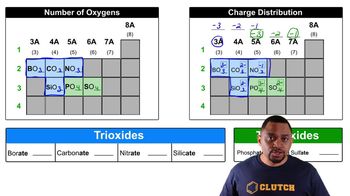
    Trioxides have 3 oxygens, and they form the letter 'T' on the periodic table as a memory trick.
  • Which elements commonly form tetraoxides and how many oxygens do they have?

    Phosphorus and sulfur commonly form tetraoxides, which have 4 oxygens each.
  • How do you determine the charge of trioxides based on their group in the periodic table?

    Starting from group 3A, trioxides have a charge of -3, group 4A have -2, and group 5A have -1.
  • What are the names and formulas for the common trioxides?

    Borate (BO3^3-), carbonate (CO3^2-), nitrate (NO3^-), and silicate (SiO3^2-).
  • What are the names and formulas for the common tetraoxides?

    Phosphate (PO4^3-) and sulfate (SO4^2-).
  • What happens to the name and formula of a polyatomic ion when you decrease the number of oxygens by one?

    The ending changes from -ate to -ite, but the overall charge stays the same.
  • What is the charge on all halogen oxyanions (oxyanions containing halogens)?

    All halogen oxyanions have a -1 charge.
  • How does the number of oxygens affect the naming of halogen oxyanions?

    Four oxygens use the prefix 'per-' and suffix '-ate', three oxygens use '-ate', two use '-ite', and one uses the prefix 'hypo-' and suffix '-ite'.
  • What is the only major polyatomic ion with a +1 charge you need to know?

    The ammonium ion, NH4^+.
  • What is the formula and charge for the mercury(I) ion?

    The mercury(I) ion is Hg2^2+, consisting of two Hg^+ ions bonded together.
  • Name three 'other' tetraoxides and their formulas.

    Permanganate (MnO4^-), chromate (CrO4^2-), and oxalate (C2O4^2-).
  • What is the formula for cyanide and how does it differ from cyanate?

    Cyanide is CN^-, while cyanate is OCN^- (or CNO^-), which includes an oxygen.
  • What are two common ways to write the formula for the acetate ion?

    Acetate can be written as C2H3O2^- or CH3COO^-.