Redox Reactions quiz #1 Flashcards
You can tap to flip the card.
Control buttons has been changed to "navigation" mode.
1/40
Which of the following is not an oxidation-reduction (redox) reaction?
A reaction in which there is no transfer of electrons between reactants is not a redox reaction.What is it called when a substance loses electrons and oxygen is acquired?
This process is called oxidation.Which substance loses electrons in a chemical reaction?
The substance that is oxidized loses electrons in a chemical reaction.Why is reduction the term used to describe the gain of an electron?
Reduction refers to the gain of electrons because the oxidation number of the substance decreases.Which of the following is true about a redox reaction?
A redox reaction involves the transfer of electrons between substances, changing their oxidation states.Which of the following species is the best reducing agent?
The best reducing agent is the species most easily oxidized, meaning it readily loses electrons.Which equation describes a reduction?
An equation showing a species gaining electrons, such as Cu2+ + 2e- → Cu, describes a reduction.What happens when atomic oxygen contacts things that are already oxidized?
Atomic oxygen will not further oxidize substances that are already fully oxidized.Which chemical equation represents a redox reaction?
An equation where electrons are transferred between reactants, such as Zn + Cu2+ → Zn2+ + Cu, represents a redox reaction.Which identifies an oxidation-reduction reaction?
A reaction where the oxidation states of elements change due to electron transfer is an oxidation-reduction reaction.What is the oxidation half-reaction for a fuel cell?
The oxidation half-reaction involves a species losing electrons, such as H2 → 2H+ + 2e-.Oxidation is defined as the loss of one or more of which of the following?
Oxidation is defined as the loss of one or more electrons.What is the key characteristic of an oxidation–reduction reaction?
The key characteristic is the transfer of electrons between reactants.What happens when an atom in a reactant gains electrons?
When an atom gains electrons, it is reduced and its oxidation number decreases.Which of the following is not an example of oxidation?
A process where a substance gains electrons is not an example of oxidation.Which of the following equations represents an oxidation-reduction reaction?
An equation where the oxidation numbers of elements change, such as Fe + Cu2+ → Fe2+ + Cu, represents a redox reaction.Is the reaction shown an oxidation?
If the reaction involves a substance losing electrons, then it is an oxidation.Which metal can be a sacrificial anode for an iron pipe?
A metal more easily oxidized than iron, such as zinc or magnesium, can serve as a sacrificial anode.Rust will form on an iron nail when what has occurred?
Rust forms when iron is oxidized, typically by reacting with oxygen and water.Which molecule is reduced in an oxidation-reduction reaction?
The molecule that gains electrons is reduced in a redox reaction.Which reaction is an oxidation-reduction reaction?
A reaction where electrons are transferred between reactants is an oxidation-reduction reaction.Which equation represents an oxidation-reduction reaction?
An equation showing a change in oxidation states, such as 2Na + Cl2 → 2NaCl, represents a redox reaction.Which element or compound has lost electrons in this oxidation-reduction reaction?
The element or compound whose oxidation number increases has lost electrons.Which of the following is an example of reduction?
A process where a substance gains electrons, such as Fe3+ + e- → Fe2+, is an example of reduction.The addition of electrons and/or hydrogen atoms to a substrate is called what?
This process is called reduction.Which process involves the transfer of electrons?
A redox (oxidation-reduction) reaction involves the transfer of electrons.Which of the following statements is true for oxidation and reduction reactions?
Oxidation and reduction always occur together in a redox reaction.What happens to a substance when it becomes oxidized? Reduced?
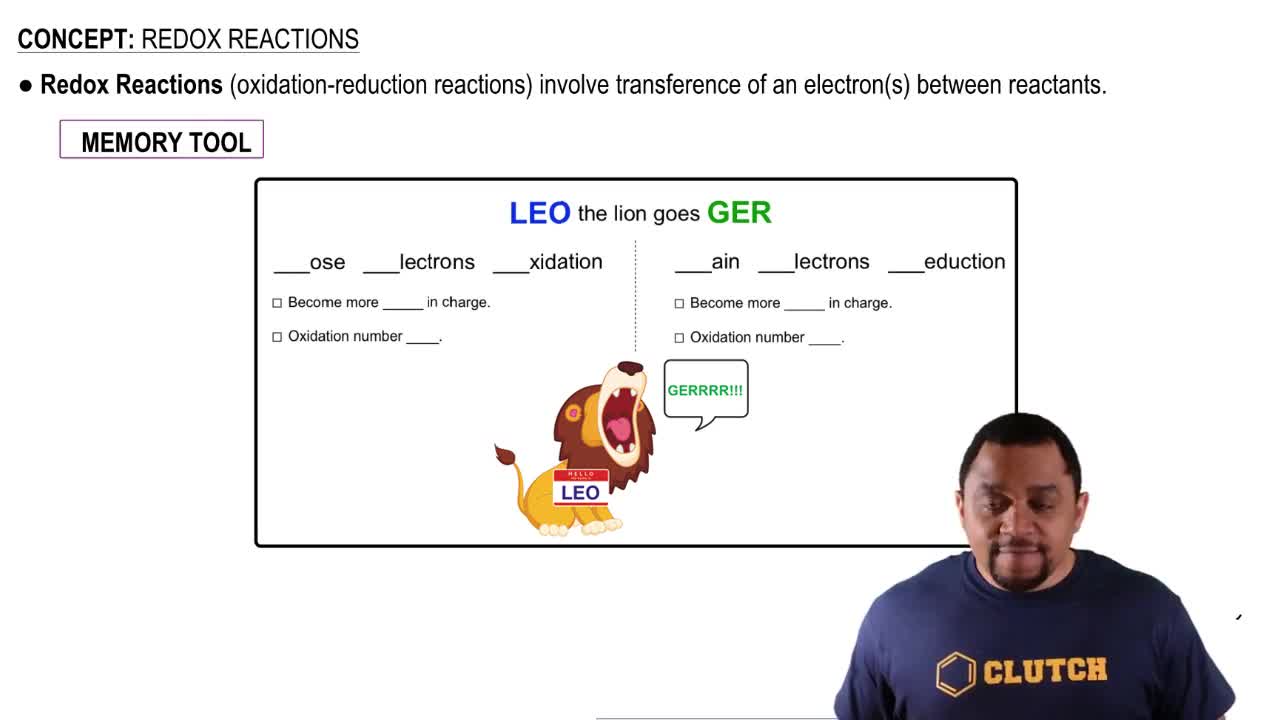
When oxidized, a substance loses electrons and its oxidation number increases; when reduced, it gains electrons and its oxidation number decreases.What happens to atoms in an oxidation-reduction reaction?
Atoms change their oxidation states due to the transfer of electrons.Which of the following represents a process in which a species is reduced?
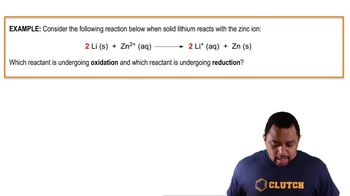
A process where a species gains electrons, such as Ag+ + e- → Ag, represents reduction.Which metal is being oxidized based on the reaction? Cu(s) + Ag+(aq) → Cu+(aq) + Ag(s)
Copper (Cu) is being oxidized in this reaction.What type of reaction involves the removal of electrons from an atom or molecule?
Oxidation involves the removal of electrons.Which compound is oxidized in the reaction shown below?
The compound whose oxidation number increases is oxidized.Which of the following reactions would be classified as oxidation-reduction?
Any reaction where electrons are transferred and oxidation states change is classified as oxidation-reduction.Which of the following metals is the strongest reducing agent?
The metal most easily oxidized is the strongest reducing agent.In an oxidation-reduction reaction,
Electrons are transferred between reactants, changing their oxidation states.Which of the following is the strongest oxidizing agent?
The species most easily reduced (gains electrons) is the strongest oxidizing agent.Which one of these changes describes an oxidation half-reaction?
A change where a species loses electrons, such as Zn → Zn2+ + 2e-, describes an oxidation half-reaction.Which of the following reactions is a redox reaction?
A reaction where electron transfer occurs, such as 2Fe + 3Cl2 → 2FeCl3, is a redox reaction.What happens during a redox reaction?
Electrons are transferred between substances, changing their oxidation states.