What is the most stable resonance structure if oxygen is the central atom in the cyanate ion (OCN−)?
The most stable resonance structure for OCN− with oxygen as the central atom has a double bond between oxygen and carbon, and a triple bond between carbon and nitrogen, with formal charges minimized.
How many resonance structures can be drawn for ozone (O3)?
Two resonance structures can be drawn for ozone (O3), with the double bond alternating between the two terminal oxygens.
Which resonance form is likely to contribute most to the correct structure of N2O?
The resonance form with a triple bond between the two nitrogens and a single bond to oxygen, with formal charges minimized, contributes most to the correct structure of N2O.
How many resonance structures can be drawn for the molecule O3?
Two resonance structures can be drawn for O3.
Each of the three resonance structures of NO3− has how many lone pairs of electrons?
Each resonance structure of NO3− has eight lone pairs of electrons: two on each oxygen atom.
Which types of compounds typically readily form resonance structures?
Compounds with pi bonds and delocalized electrons, such as polyatomic ions and molecules with multiple bonds, typically form resonance structures.
How many equivalent resonance structures can be drawn for the ion ClO4−?
Four equivalent resonance structures can be drawn for ClO4−, with the double bond rotating among the four oxygens.
Which pair of Lewis structures is not a pair of resonance structures?
Lewis structures that differ in atom connectivity, rather than just electron placement, are not resonance structures.
How important is the resonance structure shown here to the overall structure of carbon dioxide?
Resonance structures are less important for CO2 because its best Lewis structure does not involve delocalized pi bonds; the molecule is best represented by two double bonds.
In which one of the following is the best Lewis structure a resonance structure?
The best Lewis structure is a resonance structure in molecules or ions with delocalized electrons, such as NO3−.
How many resonance structures are needed to describe the structure of HNO3?
Two resonance structures are needed to describe HNO3, involving the movement of the double bond between the oxygens.
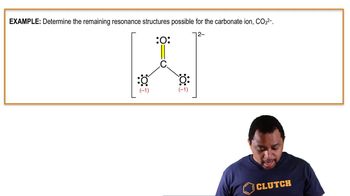
How many resonance structures can be drawn for the carbonate ion (CO3^2−)?
Three equivalent resonance structures can be drawn for the carbonate ion (CO3^2−).
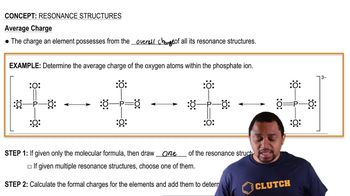
How many double bonds are present in the 'best' resonance structure of the phosphate ion (PO4^3−)?
In each resonance structure of PO4^3−, there is one double bond between phosphorus and one oxygen.
Which shows the resonance hybrid of the nitrate ion (NO3−)?
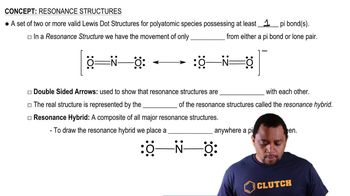
The resonance hybrid of NO3− is shown by placing dotted lines between nitrogen and each oxygen, indicating delocalized pi bonds.
Which condition will result in resonance?
Resonance occurs when a molecule or ion has multiple valid Lewis structures due to delocalized electrons in pi bonds or lone pairs.
Which molecule will not exhibit resonance? Select the correct answer below: NO2−, NO3−, CO3^2−, H2O
H2O will not exhibit resonance because it does not have delocalized pi bonds.
Which of the species below will exhibit resonance? CO2
CO2 does not exhibit resonance; its best Lewis structure has two double bonds and no delocalized electrons.
How many equivalent resonance structures can be drawn for the ion BrO3−?
Three equivalent resonance structures can be drawn for BrO3−, with the double bond rotating among the three oxygens.
Which of the following molecules or ions will exhibit delocalized bonding? NO2−, NH4+, N3−
NO2− and N3− will exhibit delocalized bonding due to resonance; NH4+ does not.
How many resonance structures can be drawn for ozone, O3?
Two resonance structures can be drawn for ozone (O3).
Draw all resonance structures for the acetate ion, CH3COO−.
The acetate ion has two resonance structures: one with a double bond to one oxygen and a single bond to the other, and vice versa.
Draw the Lewis structure and resonance forms for S2O.
S2O has resonance structures with the double bond alternating between the two sulfur atoms and the oxygen atom.
Draw all resonance structures for the carbonate ion, CO3^2−.
CO3^2− has three resonance structures, each with a double bond to a different oxygen and single bonds to the other two.
Draw the resonance structures for NO2−.
NO2− has two resonance structures, with the double bond alternating between the two oxygens attached to nitrogen.