Solubility Rules quiz #1 Flashcards

Solubility Rules quiz #1
Control buttons has been changed to "navigation" mode.
1/40
  • Which of the following ions will cause a precipitate to form in the presence of phosphate?

    Most cations except Group 1A and ammonium will form insoluble phosphates, causing a precipitate.
  • What is the name of the phenomenon where water molecules surround ions to help separate them?

    This phenomenon is called solvation or hydration.
  • Substance A dissolves in water. What can be said about substance A?

    Substance A is soluble in water.
  • Which would increase the rate of dissolving salt into water?

    Increasing temperature, stirring, or crushing the salt increases the rate of dissolving.
  • Which statement explains why sugar dissolves easily in water?

    Sugar is polar and forms hydrogen bonds with water, making it soluble.
  • How does temperature affect solubility?

    Increasing temperature generally increases the solubility of solids in liquids.
  • What does soluble mean?

    Soluble means a substance can dissolve in a solvent to form a solution.
  • Which of the following is the only lead compound that is completely soluble in water?

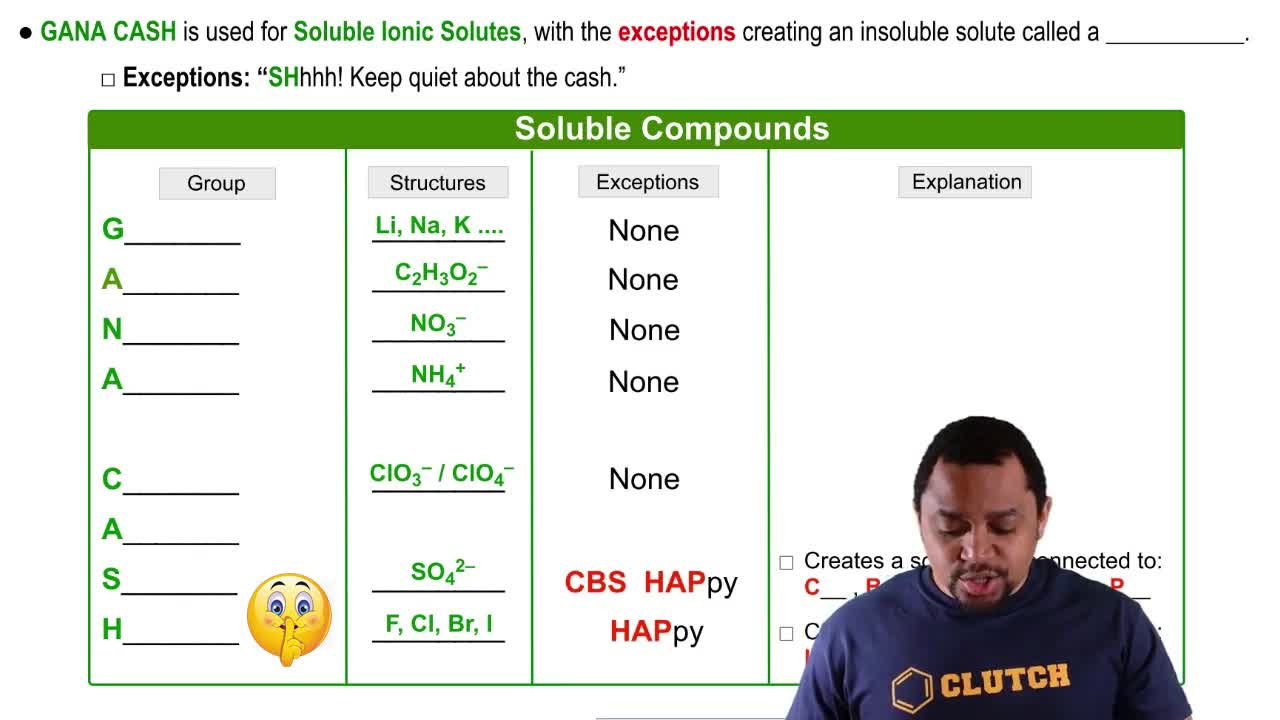
    Lead compounds with nitrate, acetate, or chlorate ions are soluble.
  • Which of the following phosphate salts are insoluble in water?

    Most phosphate salts are insoluble except those with Group 1A or ammonium ions.
  • Which one of the following would form a precipitate when mixed with aqueous Ba(NO3)2?

    Sulfate ions (SO4^2-) will form a precipitate of BaSO4 with Ba(NO3)2.
  • Which of the following salts would have the greatest solubility in water?

    Salts containing Group 1A ions or ammonium are most soluble.
  • Which of the following is true when salt is dissolved into water?

    Salt dissociates into its ions, which become surrounded by water molecules.
  • What does it mean when we say a substance is water-soluble?

    It means the substance can dissolve in water to form a homogeneous solution.
  • For which of the following aqueous solutions will a decrease of pH increase the solubility?

    Compounds containing basic anions like carbonates or phosphates become more soluble at lower pH.
  • Which compound is insoluble in water?

    Compounds containing carbonate, phosphate, or sulfide ions (except with Group 1A or ammonium) are insoluble.
  • Which interactions and processes contribute to the dissolution of ionic compounds in water?

    Ion-dipole interactions and hydration of ions contribute to dissolution.
  • Which would be least likely to completely dissolve in water?

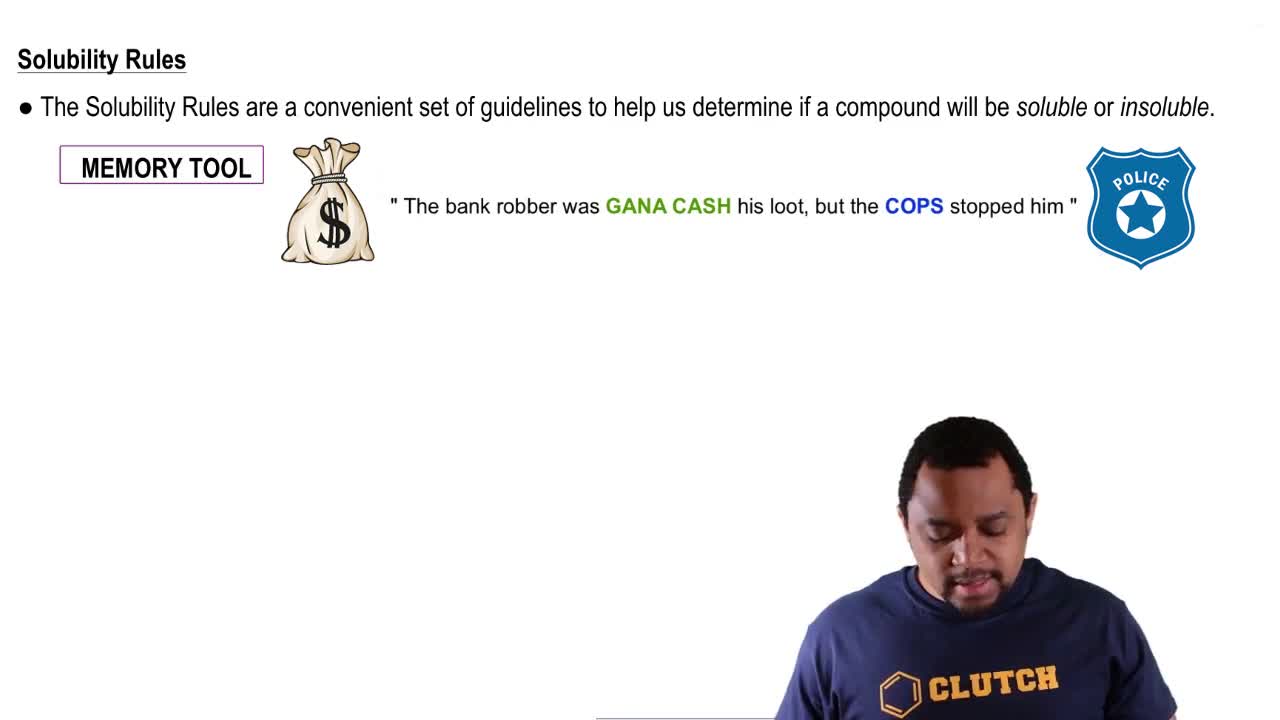
    Nonpolar substances and salts with COPS ions (except exceptions) are least likely to dissolve.
  • Which actions are part of the dissolution process of an ionic solute in water?

    Breaking ionic bonds, hydration of ions, and dispersion in solution.
  • Which of the following substances is least soluble in water?

    Nonpolar substances and salts with COPS ions are least soluble.
  • Which of these substances will water dissolve?

    Water dissolves polar and ionic substances, especially those with Group 1A, ammonium, nitrate, or acetate ions.
  • Which one of the following would form a precipitate with PO4^3- ions in aqueous solution?

    Most metal cations except Group 1A and ammonium will form precipitates with PO4^3-.
  • Why does sugar dissolve in water?

    Sugar is polar and forms hydrogen bonds with water, allowing it to dissolve.
  • Which of the following would become more soluble in water at higher pressure?

    Gases become more soluble in water at higher pressure.
  • Which substance will most likely ionize when it is dissolved in water?

    Ionic compounds like NaCl or CaCl2 will ionize in water.
  • Which of the following salts is soluble in water?

    Salts with Group 1A, ammonium, nitrate, or acetate ions are soluble.
  • Which of the following salts is insoluble in water?

    Salts with carbonate, phosphate, or sulfide ions (except exceptions) are insoluble.
  • Which of the following substances cannot be dissolved by water?

    Nonpolar substances and most COPS salts cannot be dissolved by water.
  • If CaCl2 is dissolved in water, what happens?

    CaCl2 dissociates into Ca^2+ and Cl^- ions, which are hydrated by water.
  • Which of the following would become more soluble in water at lower temperature?

    Gases are generally more soluble in water at lower temperatures.
  • Which of the following best describes supersaturation?

    Supersaturation is when a solution contains more dissolved solute than it can normally hold at a given temperature.
  • Which of the following statements is true about the solubility of N2 (g) in CH3OH (l)?

    N2 is only slightly soluble in CH3OH due to its nonpolar nature.
  • Which barium salt is insoluble in water?

    Barium sulfate (BaSO4) is insoluble in water.
  • Which group of molecules are insoluble in water?

    Nonpolar molecules and most COPS salts are insoluble in water.
  • Which process occurs as an ionic salt completely dissolves in solution?

    The salt dissociates into ions, which are hydrated by water molecules.
  • Which of the following compounds is soluble in water?

    Compounds with Group 1A, ammonium, nitrate, or acetate ions are soluble.
  • Which one of the following would not form a precipitate with Ag+ in solution?

    Nitrate, acetate, and perchlorate ions do not form precipitates with Ag+.
  • Why are some solutes soluble in water and some solutes soluble in cyclohexane?

    Polar solutes dissolve in polar solvents like water; nonpolar solutes dissolve in nonpolar solvents like cyclohexane.
  • Which of the following salts would have the lowest solubility in water?

    Salts with carbonate, phosphate, or sulfide ions (except exceptions) have the lowest solubility.
  • When copper (II) sulfate is dissolved in water, what happens?

    CuSO4 dissociates into Cu^2+ and SO4^2- ions, which are hydrated by water.
  • Which type of anion will typically result in an insoluble compound?

    Carbonate, phosphate, chromate, oxide, hydroxide, and sulfide anions typically form insoluble compounds.