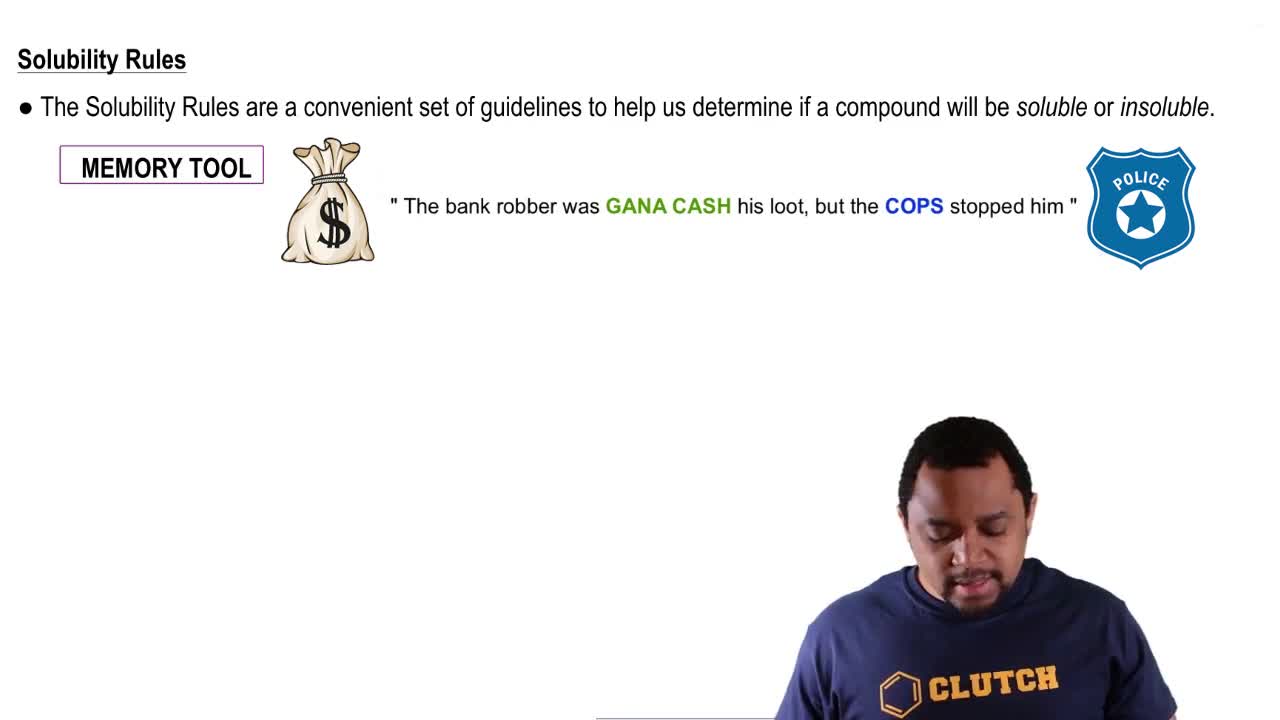
Solubility Rules quiz #5 Flashcards

Solubility Rules quiz #5
Control buttons has been changed to "navigation" mode.
1/40
  • What is supersaturation?

    Supersaturation is when a solution contains more dissolved solute than it can normally hold.
  • What is meant by supersaturation?

    A supersaturated solution contains more solute than is normally possible at a given temperature.
  • What is missing from the solubility graph shown on the right?

    The axes labels, such as temperature and solubility, may be missing.
  • Under which conditions will sugar most likely dissolve fastest in a cup of water?

    Sugar dissolves fastest in hot water with stirring.
  • What happens when a solid is dissolved into a liquid?

    The solid disperses into the liquid, forming a solution.
  • Which substance will most likely dissociate when it is dissolved in water: NO2, N2F6, CaCl2, C6H12O6?

    CaCl2 will most likely dissociate in water.
  • Which type of substance is water able to dissolve?

    Water dissolves polar and ionic substances.
  • Which molecule is less soluble in water--a fat or a phospholipid? Why?

    Fat is less soluble because it is nonpolar; phospholipids have polar regions.
  • What is the solubility of Na2HAsO4 at 60°C?

    Refer to solubility data; generally, sodium salts are highly soluble.
  • How many grams of NaCl will be needed to form 600 mL of a saturated solution at 100°C?

    Refer to solubility data for NaCl at 100°C and calculate for 600 mL.
  • Which product in the reaction forms a precipitate: PbSO4, MgCl2, PbMg, no precipitate formed?

    PbSO4 forms a precipitate.
  • Which of the following best describes what takes place during the solvation process?

    Solute particles are surrounded by solvent molecules, dispersing in solution.
  • Which processes are involved when water dissolves sugar? Check all that apply.

    Hydrogen bonding, breaking sugar-sugar interactions, and dispersing sugar molecules.
  • What is the role of a solvent?

    A solvent dissolves the solute to form a solution.
  • Which one of the following will dissociate into the largest number of ions in solution?

    A compound with the most ions per formula unit, such as AlBr3.
  • Which of the samples most likely had the highest solubility?

    The sample with the most dissolved solute at a given temperature.
  • Sugars are polar substances. Which action would make sugar more soluble in water?

    Increasing temperature makes sugar more soluble.
  • Which of the following statements is true about the solubility of CO2 (g) in H2O (l)?

    CO2 is more soluble at lower temperatures and higher pressures.
  • The mixing of which pair of reactants will result in a precipitation reaction?

    Mixing solutions that produce an insoluble product, such as AgNO3 and NaCl.
  • Which of the following compounds will have the highest molar solubility in pure water?

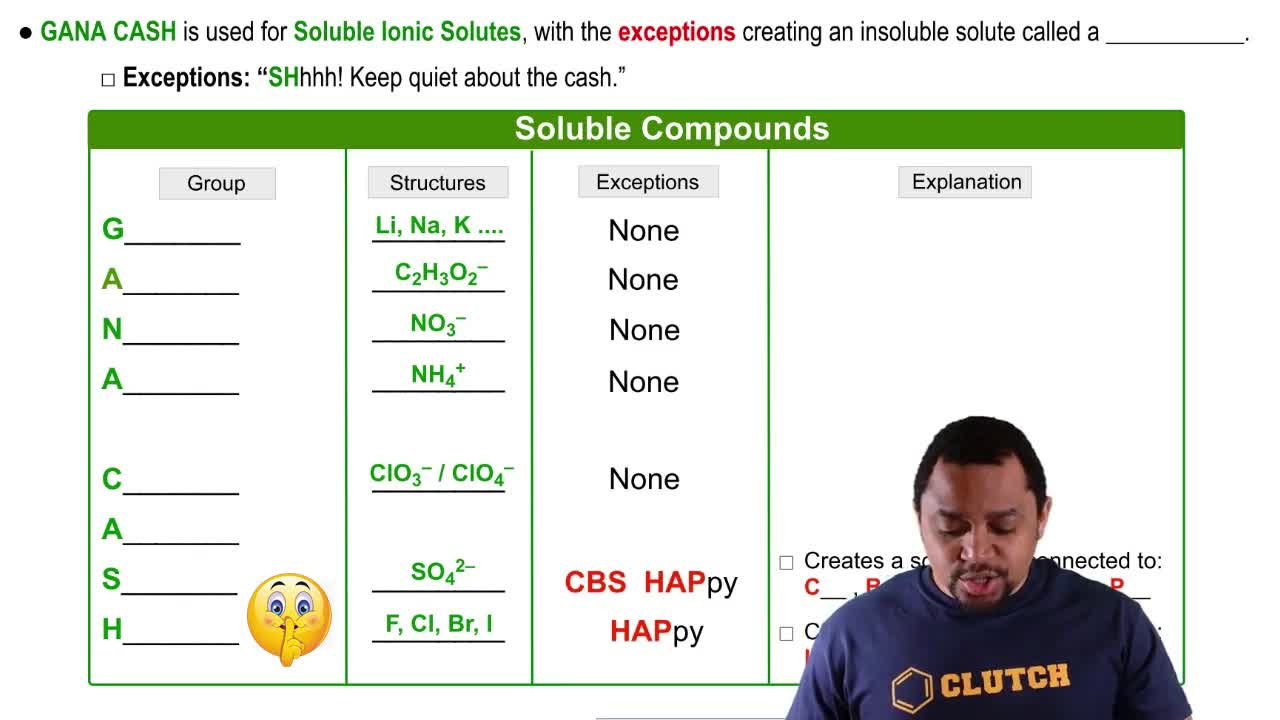
    Compounds with Group 1A, ammonium, nitrate, or acetate ions.
  • Which property is the basis of the purification technique recrystallization?

    Differences in solubility at different temperatures.
  • Which of the following statements is true about the solubility of O2 (g) in H2O (l)?

    O2 is more soluble at lower temperatures and higher pressures.
  • In which of the following aqueous solutions would you expect AgCl to have the lowest solubility?

    In solutions with high Cl- concentration, AgCl has the lowest solubility.
  • Liquid carbon dioxide is a good green alternative solvent because…?

    It is non-toxic, non-flammable, and environmentally friendly.
  • How much Na3PO4 can dissolve in 200 g of water at 40°C?

    Refer to solubility data for Na3PO4 at 40°C.
  • Which water sample is most likely to have halides dissolved in it?

    Samples containing Group 1A or ammonium halides.
  • A compound has a melting point of 545 degrees Celsius and dissolves well in water. Why?

    It is likely ionic and follows solubility rules for water solubility.
  • What is the solubility of M(OH)2 in a 0.202 M solution of M(NO3)2?

    Solubility is reduced due to the common ion effect.
  • How much Na3PO4 can dissolve in 200 g of water at 40°C?

    Refer to solubility data for Na3PO4 at 40°C.
  • Which method would increase the solubility of a gas?

    Increasing pressure or decreasing temperature increases gas solubility.
  • Which ingredient listed below is compatible with both water and oil?

    Emulsifiers like phospholipids are compatible with both.
  • Which substance will most likely ionize when it is dissolved in water: HBr, CaBr2, MgCl2, KCl?

    All are ionic and will ionize, but HBr also ionizes as an acid.
  • Which contributes to the dissolution of sugar in water?

    Hydrogen bonding and breaking sugar-sugar interactions.
  • Which of the following would increase the rate of dissolution of a solid in a solution?

    Increasing temperature, stirring, or crushing the solid.
  • Which of the following correctly describes the dissolution of potassium sulfide?

    Potassium sulfide dissociates into K+ and S^2- ions; S^2- is usually insoluble except with Group 1A.
  • Which group is the most soluble in water (assuming number of carbons is equivalent)?

    Groups with polar functional groups are most soluble.
  • Which two solutions have similar solubilities at 40°C?

    Solutions with similar solute and solvent properties.
  • Which of the following is a substance which mixes easily with and dissolves in water?

    Polar and ionic substances following solubility rules.
  • How much KNO3 can dissolve in 50 g of water at 10°C?

    Refer to solubility data for KNO3 at 10°C.
  • Which item below is not an example of how the general rule for dissolving works?

    A nonpolar solute dissolving in a polar solvent is not an example.