Solubility Rules quiz #6 Flashcards

Solubility Rules quiz #6
Control buttons has been changed to "navigation" mode.
1/35
  • What is the term for the ability of a substance to dissolve in water?

    Solubility.
  • Which of the following will dissolve most rapidly?

    A finely powdered solute in hot, stirred solvent.
  • Sodium chloride (NaCl) dissolves in water because water molecules _____.

    Surround and stabilize the Na+ and Cl- ions.
  • Hexane, a nonpolar solvent, will dissolve which of the following substances?

    Nonpolar substances.
  • When aqueous solutions of ________ are mixed, a precipitate forms.

    Solutions that produce an insoluble product, such as AgNO3 and NaCl.
  • Which of the following substances has the greatest solubility in C5H12(l) at 1 atm?

    Nonpolar substances have greatest solubility in C5H12.
  • What is a solubility chart?

    A chart showing the solubility of various compounds in water at different temperatures.
  • DDT is _____-soluble so it accumulates in _____.

    DDT is fat-soluble so it accumulates in fatty tissues.
  • The solute will dissolve quicker if the solute is more shaken, saturated, cooled, or settled?

    Shaken; agitation increases dissolution rate.
  • What is the substance that is being dissolved by a solvent called?

    It is called the solute.
  • For each solute, identify the better solvent: water or carbon tetrachloride.

    Polar solutes dissolve better in water; nonpolar solutes in carbon tetrachloride.
  • The second test is for solubility. If the substance is soluble in water, then it is likely _____?

    It is likely polar or ionic.
  • Rank these substances in order of increasing solubility in water.

    Nonpolar < slightly polar < polar < ionic (following solubility rules).
  • What is a solid that forms from a solution during a chemical reaction called?

    It is called a precipitate.
  • What does partially soluble mean?

    It means a substance dissolves to a limited extent in a solvent.
  • When NaCl dissolves in water, what happens?

    NaCl dissociates into Na+ and Cl- ions, which are hydrated by water.
  • What is the ability of a substance to dissolve in another substance called?

    Solubility.
  • Based on the solubility observations, would you expect potassium and bromide to form a precipitate?

    No, potassium bromide is soluble in water.
  • Based only on intermolecular forces, which of the following would be the most soluble in CH3OH?

    Polar substances and those capable of hydrogen bonding.
  • The solubility of a salt refers to _____?

    The maximum amount of salt that can dissolve in a solvent at a given temperature.
  • Silver chromate is sparingly soluble in aqueous solutions. What does this mean?

    It dissolves only to a small extent in water.
  • The phrase 'like dissolves like' refers to _____?

    Polar solvents dissolve polar solutes; nonpolar solvents dissolve nonpolar solutes.
  • Calculate the solubility of a compound in water at a given temperature. You'll find data in the ALEKS data tab.

    Refer to the solubility data for the specific compound and temperature.
  • PbCl2 would have the highest solubility in _____?

    Hot water or in the presence of complexing agents.
  • For which of the mixtures will Ag2SO4(s) precipitate?

    Mixing solutions containing Ag+ and SO4^2- ions will precipitate Ag2SO4.
  • Arrange the salts by their molar solubility in water.

    Salts with Group 1A, ammonium, nitrate, or acetate ions > others following solubility rules.
  • What happens when ionic compounds dissolve in water?

    They dissociate into ions, which are hydrated by water.
  • Enter the solubility expression for Mg3(PO4)2(s).

    Ksp = [Mg^2+]^3 [PO4^3-]^2
  • Is Li3PO4 soluble in water?

    Lithium phosphate is soluble due to the Group 1A cation.
  • Understanding the effect of pH on the solubility of ionic compounds.

    Lowering pH increases solubility of compounds with basic anions.
  • Classify these compounds as soluble or insoluble.

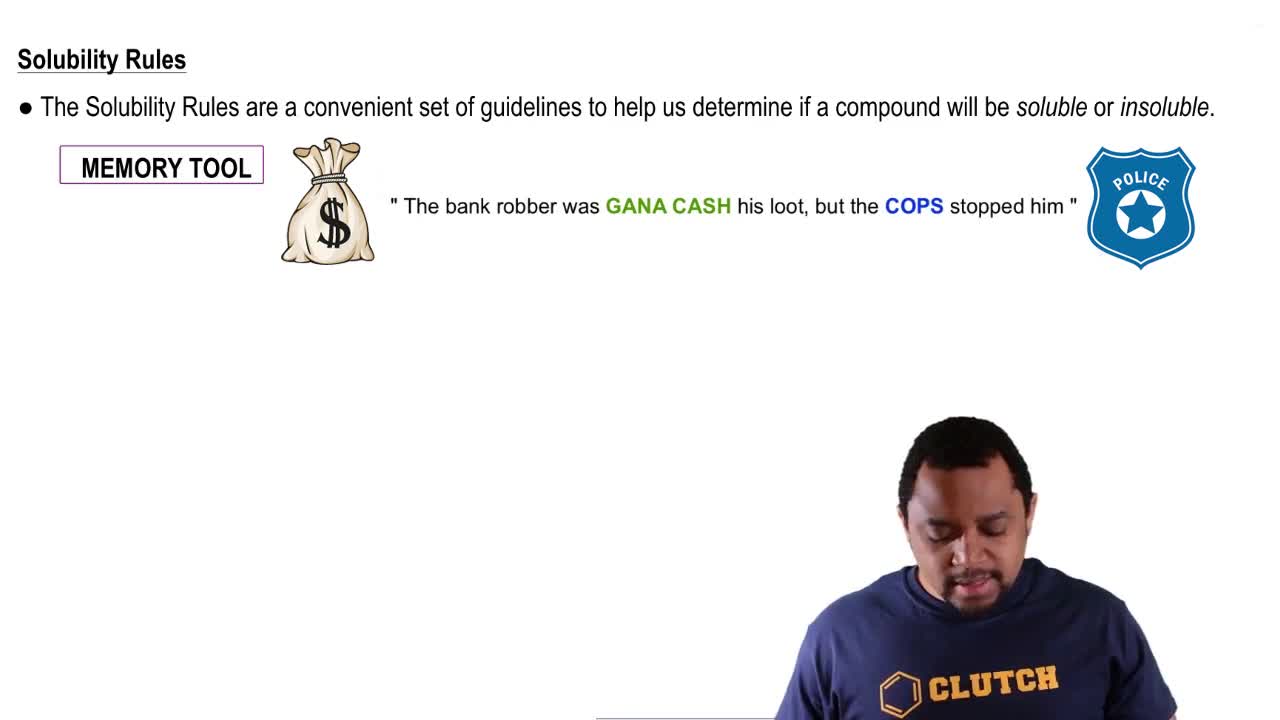
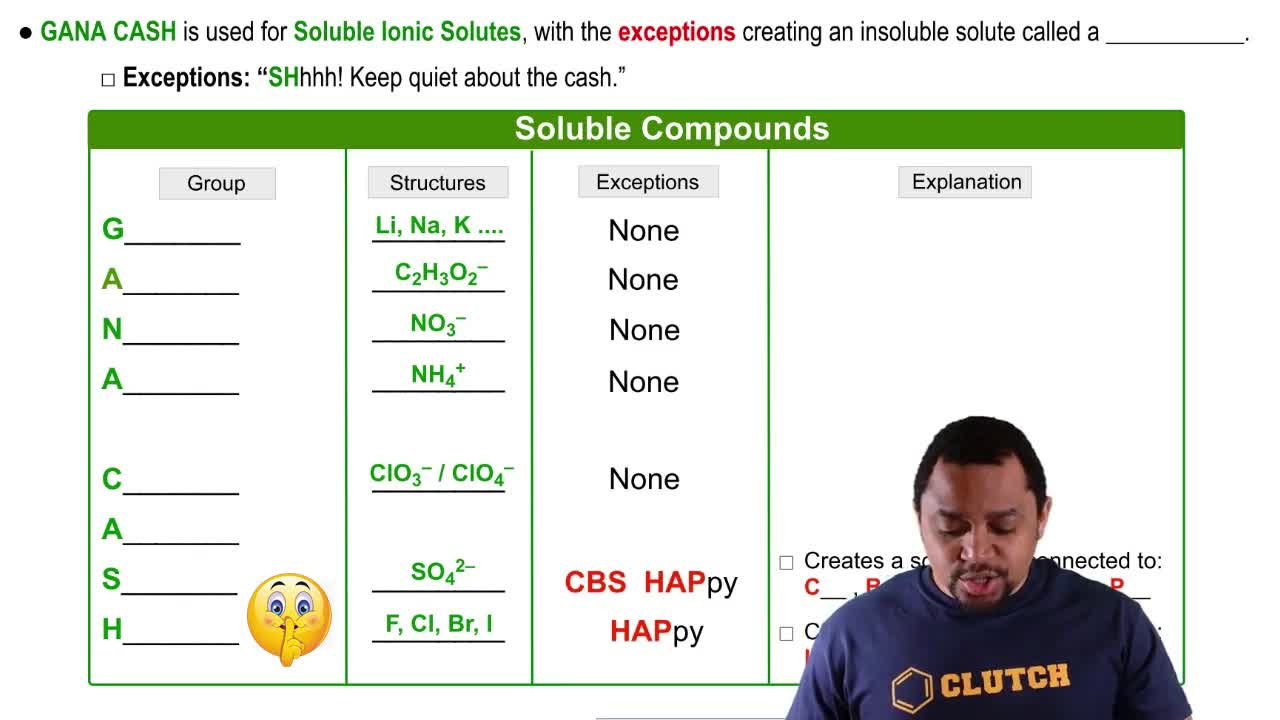
    Use solubility rules: Group 1A, ammonium, nitrate, acetate, chlorate, perchlorate are soluble; COPS ions are insoluble except exceptions.
  • What are the major species present when a compound is dissolved in water?

    The dissociated ions and water molecules.
  • Predict whether the compounds are soluble or insoluble in water.

    Apply solubility rules to predict solubility.
  • Determine if each compound shown is soluble or insoluble.

    Use solubility rules to determine solubility.
  • Which of the compounds is more soluble in an acidic solution than in pure water?

    Compounds with basic anions like CO3^2-, PO4^3-, or S^2-.