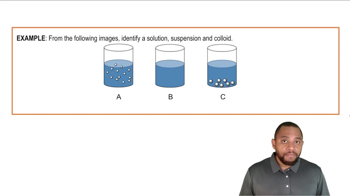
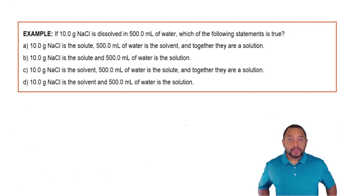
A solute is the substance that is dissolved in the solvent, present in a smaller amount within a solution.
Which solution is typically used as a positive control in experiments?
A positive control is a solution known to produce a specific effect, used to validate the experimental setup.
Which solution has the highest water concentration: a sugar solution, a salt solution, or pure water?
Pure water would have the highest water concentration as it contains no solutes.
What is a solution that has a lower solute concentration when compared to another solution called?
A solution with a lower solute concentration compared to another is called a hypotonic solution.
How are solutes present within a solution?
Solutes are dissolved in the solvent, forming a homogeneous mixture.
What is the main difference between a solution and a suspension?
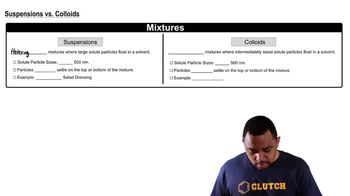
A solution is a homogeneous mixture where solutes are completely dissolved, while a suspension is a heterogeneous mixture with large particles that can settle out.
How do colloids differ from solutions?
Colloids are homogeneous mixtures with intermediate-sized particles that remain suspended, unlike solutions where particles are completely dissolved.
What is the typical particle size range for colloids?
Colloids have particles less than 500 nanometers in size.
Why do particles in suspensions eventually settle?
Particles in suspensions are larger than 500 nanometers, allowing them to settle due to gravity.
What is an example of a colloid?
Milk is an example of a colloid, with fat and proteins suspended throughout the liquid.