Back

Stoichiometry quiz

Control buttons has been changed to "navigation" mode.
1/15
  • What is the first step you must do before performing any stoichiometric calculation?

    You must first balance the chemical equation.
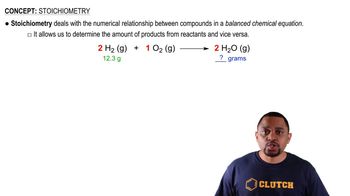
  • What does stoichiometry allow you to determine in a chemical reaction?

    Stoichiometry allows you to determine the amount of products from reactants and vice versa.
  • In stoichiometry, what is the 'given information'?

    The 'given information' is the quantity of a substance provided in the problem, such as grams, ions, atoms, formula units, or molecules.
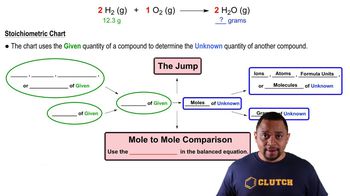
  • What is the purpose of the stoichiometric chart?

    The stoichiometric chart helps you convert the given quantity of a compound to the unknown quantity of another compound.
  • Why is it important to use a balanced equation in stoichiometry?

    A balanced equation ensures the correct mole-to-mole relationships between reactants and products for accurate calculations.
  • What is the 'jump' in stoichiometry?

    The 'jump' refers to the step where you use a mole-to-mole comparison to move from moles of the given substance to moles of the unknown substance.
  • How do you perform the 'jump' in stoichiometric calculations?

    You use the coefficients from the balanced equation to compare moles of the given substance to moles of the unknown substance.
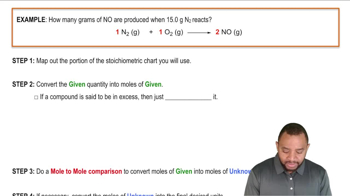
  • If you are given grams of a substance, what is the first conversion you should make?

    You should first convert grams of the given substance to moles of the given substance.
  • After finding moles of the unknown, what are two possible next steps depending on the question?

    You can either stop if the answer is needed in moles, or convert to grams, ions, atoms, formula units, or molecules of the unknown.
  • What is the path you follow in a typical stoichiometric calculation starting with grams of a reactant?

    You go from grams of given to moles of given, then to moles of unknown, and finally to grams of unknown.
  • What information do you need to perform a mole-to-mole comparison?

    You need the coefficients from the balanced chemical equation.
  • What types of quantities can the 'given information' be expressed as in stoichiometry?

    The given information can be in grams, ions, atoms, formula units, or molecules.
  • Why is the mole-to-mole comparison called a 'leap of faith' in stoichiometry?

    Because you move from information you know (given) to information you don't know (unknown) using the balanced equation.
  • What is the final goal of a stoichiometric calculation?

    The goal is to determine the mass or number of particles of a product or reactant in a chemical reaction.
  • What tool can you use to help answer any type of stoichiometric question?

    You can use the stoichiometric chart to systematically solve stoichiometry problems.