Temperature quiz #1 Flashcards

Temperature quiz #1
Control buttons has been changed to "navigation" mode.
1/40
  • Do molecules move faster in a hot cup of coffee or a cold cup of coffee?
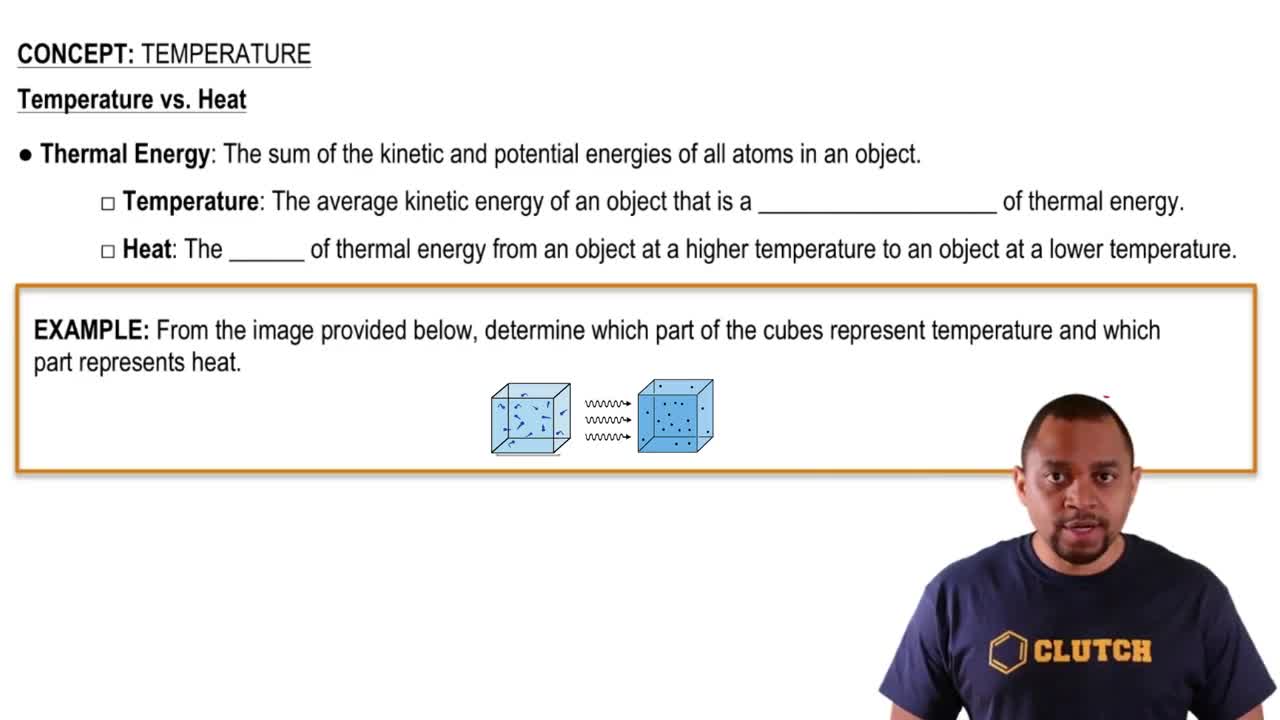
    Molecules move faster in a hot cup of coffee because higher temperature increases the average kinetic energy of the molecules.
  • Which two properties determine which substance has the higher temperature?
    The average kinetic energy of the particles and the type of substance determine which has the higher temperature.
  • What is the relationship between temperature and how quickly molecules move in matter?
    As temperature increases, the average kinetic energy and speed of molecules increase.
  • Which is a measure of the average kinetic energy of the particles in a sample of matter?
    Temperature is a measure of the average kinetic energy of the particles.
  • How does changing the temperature affect a chemical reaction?
    Increasing temperature generally increases the rate of a chemical reaction by causing particles to move faster and collide more often.
  • What happens to the molecules of water when the temperature of the water increases?
    The molecules move faster as their average kinetic energy increases.
  • What is 103°F in Celsius? Use the equation °C = (°F - 32) ÷ 1.8.
    103°F is approximately 39.4°C.
  • What is the boiling and freezing point of water?
    Water boils at 100°C (212°F) and freezes at 0°C (32°F) under standard atmospheric pressure.
  • Which temperature would increase the rate of diffusion?
    A higher temperature increases the rate of diffusion.
  • Which scale for measuring temperature has zero as the point that water freezes?
    The Celsius scale has zero as the freezing point of water.
  • What is the temperature of the gas (in kelvin) at point A?
    The temperature in kelvin at point A depends on the specific value given; to convert from Celsius, use K = °C + 273.15.
  • What is the boiling point of water in degrees Celsius?
    The boiling point of water is 100°C.
  • What is the value for absolute zero?
    Absolute zero is 0 K, which is -273.15°C.
  • Does temperature affect the rate of reaction?
    Yes, increasing temperature generally increases the rate of reaction.
  • What effect does a decrease in temperature have on the overall rate of a chemical reaction?
    A decrease in temperature slows down the rate of a chemical reaction.
  • What does temperature measure about a substance?
    Temperature measures the average kinetic energy of the particles in a substance.
  • Which shows the formula for converting from kelvins to degrees Celsius?
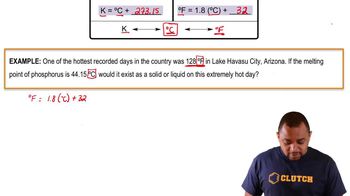
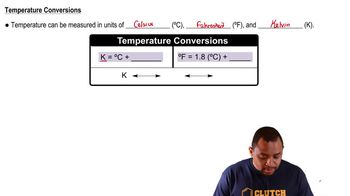
    °C = K - 273.15
  • Which of these is a measure of the average kinetic energy of the molecules of a material?
    Temperature is the measure of the average kinetic energy.
  • Which of the following statements about temperature changes on mercury is correct?
    Temperature changes on mercury refer to the change in average kinetic energy of its particles.
  • How is the Kelvin scale different from the Fahrenheit and Celsius scales?
    The Kelvin scale starts at absolute zero (0 K) and does not use negative values; it is an absolute temperature scale.
  • At what temperature is the reading on a Fahrenheit scale twice the reading on a Celsius scale?
    At -40°, the reading is the same on both Fahrenheit and Celsius scales.
  • What formula is used when changing from Celsius to Kelvin?
    K = °C + 273.15
  • What is the freezing point of water on the Celsius temperature scale?
    The freezing point of water is 0°C.
  • At what temperature range is water a liquid?
    Water is a liquid between 0°C and 100°C at standard atmospheric pressure.
  • Why is the Celsius scale sometimes called 'centigrade'?
    Because it is divided into 100 degrees between the freezing and boiling points of water.
  • What happens as you decrease the temperature of a solution?
    The particles move more slowly as their average kinetic energy decreases.
  • What is the boiling point of water on a Celsius thermometer?
    The boiling point of water is 100°C.
  • What is the melting point of water in Celsius?
    The melting point of water is 0°C.
  • Which temperature scales have equal sized degrees?
    Celsius and Kelvin scales have equal sized degrees.
  • Temperature in the desert is 113 degrees Fahrenheit. What is this temperature in Celsius?
    113°F is approximately 45°C.
  • What's the temperature –15°F in degrees Celsius?
    –15°F is approximately –26.1°C.
  • A Fahrenheit thermometer registers 80 degrees F outside. What would a Celsius thermometer read?
    80°F is approximately 26.7°C.
  • Temperature is a measure of what?
    Temperature measures the average kinetic energy of the particles in a substance.
  • What scale for measuring temperature has 32 degrees as the point at which water freezes?
    The Fahrenheit scale.
  • What is the boiling point of water on the Celsius temperature scale?
    100°C.
  • What is the lowest possible temperature on the Celsius scale? On the Kelvin scale?
    The lowest possible temperature is –273.15°C (0 K).
  • What is the boiling point of water on the Celsius scale?
    100°C.
  • At which temperature will ice melt under normal conditions?
    Ice melts at 0°C under normal conditions.
  • At what temperature does water boil in kelvin?
    Water boils at 373.15 K.
  • What is the boiling point of water in kelvin?
    373.15 K.