Temperature quiz #2 Flashcards

Temperature quiz #2
Control buttons has been changed to "navigation" mode.
1/40
  • At 100°C, what phase change does water undergo?
    At 100°C, water boils and changes from liquid to gas.
  • Seventy-four degrees Fahrenheit is equal to what temperature in Celsius?
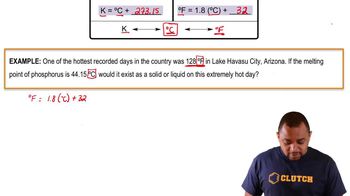
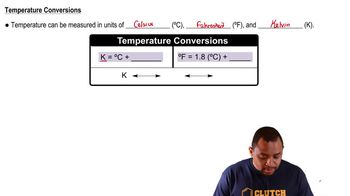
    74°F is approximately 23.3°C.
  • What is the boiling point of water in kelvins?
    373.15 K.
  • What unit of temperature is used in gas law calculations?
    Kelvin is used in gas law calculations.
  • What measures the average kinetic energy in a substance?
    Temperature.
  • What is the relationship between thermal energy and temperature?
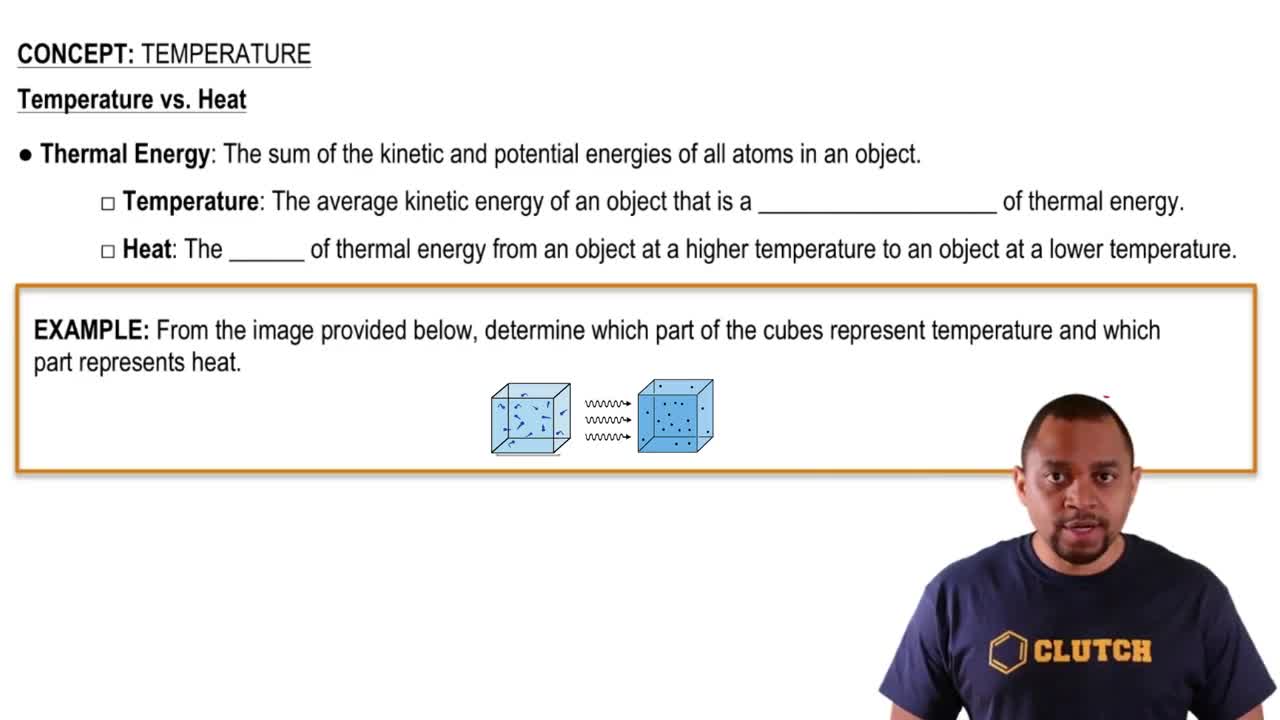
    Temperature measures average kinetic energy, while thermal energy is the total kinetic and potential energy of all particles.
  • At what temperature is the boiling point of this substance?
    The boiling point depends on the substance; for water, it is 100°C or 373.15 K.
  • Which temperature scale has the smallest sized degrees?
    The Fahrenheit scale has the smallest sized degrees.
  • What is the general relationship between temperature and reaction rate?
    As temperature increases, reaction rate generally increases.
  • What is 25°C in °F?
    25°C is 77°F.
  • What is the freezing point of water on the Celsius scale?
    0°C.
  • What is absolute zero on the Celsius temperature scale?
    –273.15°C.
  • What scale is used to measure absolute temperature?
    The Kelvin scale.
  • Water freezes at what temperature on the Celsius scale?
    0°C.
  • How is temperature different from thermal energy?
    Temperature is the average kinetic energy per particle; thermal energy is the total energy of all particles.
  • What is the boiling/condensation point of water in kelvin?
    373.15 K.
  • What is the high/low temperature on mercury?
    The high and low temperatures on mercury refer to the maximum and minimum temperatures measured, depending on the context.
  • Zero is the freezing temperature of water on which temperature scale?
    Celsius scale.
  • Which temperature is the freezing point of water in the Celsius scale?
    0°C.
  • What happens to the particles of a substance as its temperature increases?
    The particles move faster as their average kinetic energy increases.
  • At what temperature does water boil?
    Water boils at 100°C (212°F) at standard atmospheric pressure.
  • Which is equal to a temperature of 20°C?
    68°F.
  • Which of the following is true of temperature?
    Temperature is an intensive property and measures average kinetic energy.
  • What temperature does water boil at?
    100°C (212°F) at standard atmospheric pressure.
  • What temperature does water boil?
    100°C (212°F) at standard atmospheric pressure.
  • What is the temperature of a substance a measure of?
    The average kinetic energy of its particles.
  • Water boils at what temperature?
    100°C (212°F) at standard atmospheric pressure.
  • What happens when water is heated?
    The water molecules move faster as their kinetic energy increases.
  • How does the mean speed of the water molecules change as they are heated?
    The mean speed increases as temperature increases.
  • What is the temperature at which water boils?
    100°C (212°F) at standard atmospheric pressure.
  • At which temperature does water freeze?
    0°C (32°F).
  • At what temperature Celsius does water boil?
    100°C.
  • A thermometer used to measure the temperature of air must be accurate to what temperature?
    It should be accurate to at least 0.1°C for scientific purposes.
  • Which of the following increases the motion of atoms and molecules?
    Increasing temperature.
  • Which temperature is equal to 120 K?
    –153.15°C.
  • What happens to molecules when the temperature of their environment increases?
    They move faster as their kinetic energy increases.
  • What happens to the particles when you raise the temperature of the substance?
    The particles move faster and have more kinetic energy.
  • At what temperature does the numerical value in °F match the numerical value in °C?
    At –40°, the values are the same in both scales.
  • What is the temperature that is the same numerical value on both the Fahrenheit and Celsius scale?
    –40°.
  • What temperature is the freezing point for water?
    0°C (32°F).