Temperature quiz #3 Flashcards

Temperature quiz #3
Control buttons has been changed to "navigation" mode.
1/40
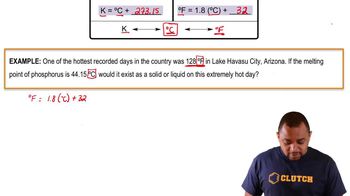
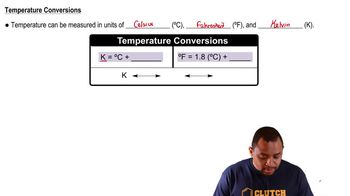
  • If the temperature is 20°C, what is it in Fahrenheit?
    68°F.
  • Which statement about temperature is correct?
    Temperature is an intensive property and measures average kinetic energy.
  • What is the Celsius scale based on?
    The freezing and boiling points of water (0°C and 100°C).
  • What's the temperature of 10°C in degrees Fahrenheit?
    10°C is 50°F.
  • What is the freezing point of water on the Fahrenheit temperature scale?
    32°F.
  • What is the freezing point on the Celsius temperature scale?
    0°C.
  • On the Celsius scale, what is the boiling point of water?
    100°C.
  • What do we use to classify the temperature?
    Temperature scales such as Celsius, Fahrenheit, and Kelvin.
  • Fahrenheit can be converted to Rankine by adding what number?
    Add 459.67 to the Fahrenheit temperature.
  • What happens when the dew point is below 0°C?
    Water vapor can deposit as frost instead of dew.
  • What is the temperature in kelvin of freezing water?
    273.15 K.
  • Which is a temperature of zero on the Kelvin scale?
    Absolute zero (0 K).
  • In which of the following pairs of characteristics of an element are the temperatures the same?
    The freezing and melting points are the same for a pure substance.
  • At what temperature does water melt?
    0°C (32°F).
  • What is the freezing point of water on the Fahrenheit scale?
    32°F.
  • What's the temperature in the space?
    Outer space has a temperature close to 2.7 K (cosmic microwave background).
  • What would be the temperature in kelvin of 39°C?
    312.15 K.
  • How is temperature related to the physical change of a substance?
    Temperature changes can cause phase changes, such as melting or boiling.
  • Which is equal to a temperature of 20°C? 20°F, 68°F, 36°F, 32°F
    68°F.
  • Which is equal to a temperature of 50°F?
    10°C.
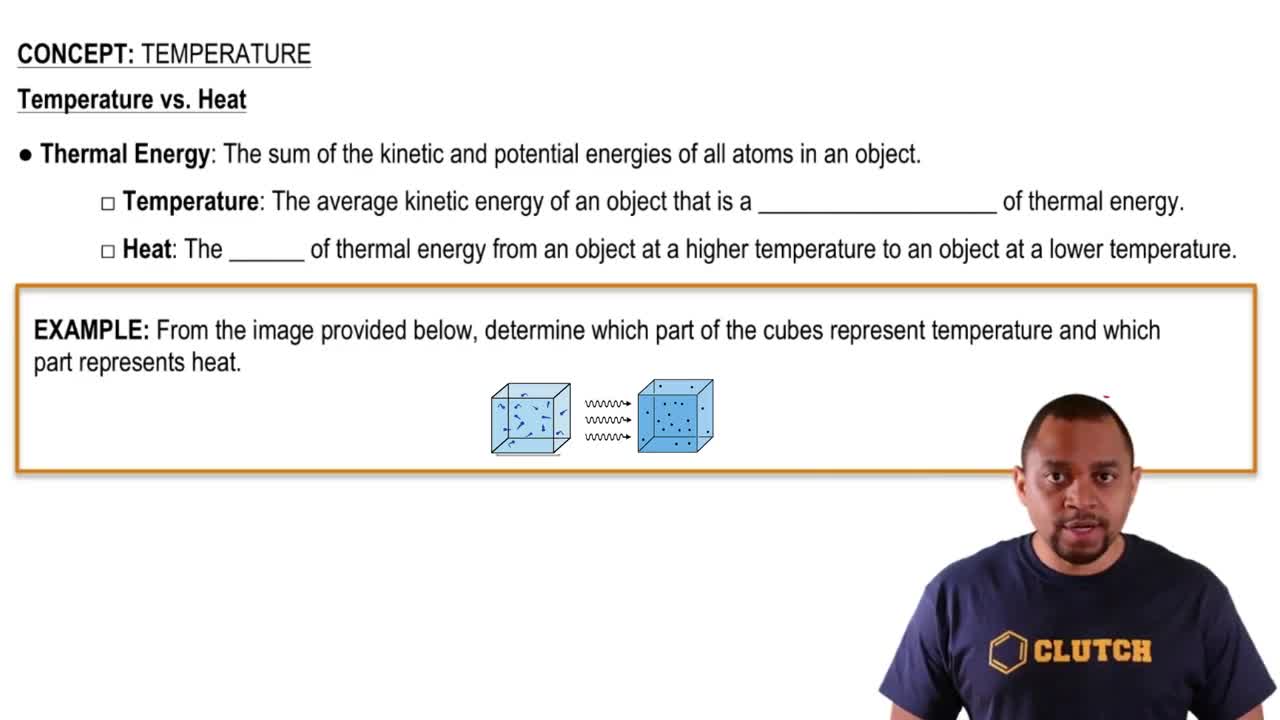
  • What is the difference between heat and temperature?
    Temperature measures average kinetic energy; heat is the transfer of thermal energy.
  • What characteristics determine how easily two substances change temperature? Check all that apply.
    Specific heat capacity and mass.
  • The temperature of water in a beaker is 45°C. What does this measurement represent?
    It represents the average kinetic energy of the water molecules.
  • Which of the following best describes temperature?
    Temperature is a measure of the average kinetic energy of particles.
  • Which of the following temperature changes are equivalent?
    A change of 1°C is equivalent to a change of 1 K.
  • What is the temperature?
    Temperature is the measure of the average kinetic energy of the particles in a substance.
  • The deep body temperature of a healthy person is 37°C. What is it in kelvins?
    310.15 K.
  • What does temperature measure?
    The average kinetic energy of the particles in a substance.
  • At what temperature does water freeze?
    0°C (32°F).
  • Which is the best reason for using a temperature probe instead of a simple laboratory thermometer?
    A temperature probe provides more precise and continuous digital readings.
  • What is the temperature range of the danger zone?
    The danger zone is typically 40°F to 140°F (4°C to 60°C) for food safety.
  • What does it mean when the temperature light/gauge is on?
    It indicates that the temperature is outside the normal or safe range.
  • At what temperature does ice melt?
    0°C (32°F).
  • At what temperature will water change from a liquid to a solid (freeze)?
    0°C (32°F).
  • Which of the following shows a temperature measurement documented correctly?
    37.0°C
  • At what temperature (in Fahrenheit) does water freeze?
    32°F.
  • How do molecules at warm temperatures differ from molecules at cool temperatures?
    Molecules at warm temperatures move faster than those at cool temperatures.
  • Which is equal to a temperature of 50°F? 18°C, 46°C, 10°C, 32°C
    10°C.
  • Which material most likely gets the warmest when placed in the sun?
    A material with low specific heat capacity and dark color will get the warmest.
  • Which of these would have the highest temperature? Ice, water, water vapor
    Water vapor.