Back

Thermal Equilibrium quiz

Control buttons has been changed to "navigation" mode.
1/15
  • What is thermal equilibrium?

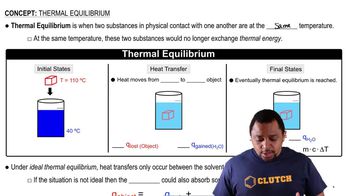
    Thermal equilibrium is when two substances in physical contact reach the same temperature and stop exchanging thermal energy.
  • What happens to heat transfer when thermal equilibrium is reached?

    Heat transfer ceases because both substances are at the same temperature.
  • In the example of a heated metal cube placed in water, which object loses heat?

    The heated metal cube loses heat, indicated by a negative Q.
  • What is the sign of Q for the object absorbing heat?

    The object absorbing heat has a positive Q.
  • What equation represents the heat lost and gained at thermal equilibrium?

    The equation is negative Q (hotter object) equals positive Q (colder object).
  • What is the formula for calculating heat (Q)?

    Q = m c ΔT, where m is mass, c is specific heat capacity, and ΔT is the change in temperature.
  • How does heat transfer direction relate to temperature difference?

    Heat always moves from the hotter object to the colder object.
  • What happens to the temperature of both objects at thermal equilibrium?

    Both objects reach the same temperature.
  • What must be considered in non-ideal thermal equilibrium situations?

    The calorimeter or container may absorb some heat, so its heat must be included in calculations.
  • How does the heat equation change when the calorimeter absorbs heat?

    The equation becomes negative Q (object) = positive Q (water) + Q (calorimeter).
  • What is the role of the calorimeter in thermal equilibrium experiments?

    The calorimeter absorbs some heat, affecting the total heat exchange.
  • What does the first law of thermodynamics state about energy exchange at equilibrium?

    At equilibrium, energy exchange stops because both substances have equal temperatures.
  • What is the significance of the negative and positive signs in Q?

    Negative Q indicates heat loss, while positive Q indicates heat gain.
  • When can you ignore the heat absorbed by the container in calculations?

    You can ignore it in ideal thermal equilibrium situations where only the solvent and object exchange heat.
  • Why is understanding thermal equilibrium important in physical systems?

    It helps explain energy transfer and the approach to thermal balance in physical systems.