Back

Thermochemical Equations quiz

Control buttons has been changed to "navigation" mode.
1/15
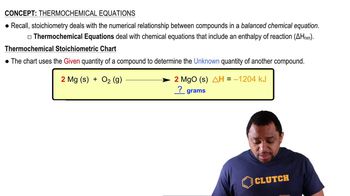
  • What does a thermochemical equation include that a regular balanced chemical equation does not?

    A thermochemical equation includes the enthalpy change of reaction (ΔHrxn) alongside the balanced chemical equation.
  • What does ΔHrxn represent in a thermochemical equation?

    ΔHrxn represents the enthalpy change, or the heat absorbed or released, during a chemical reaction.
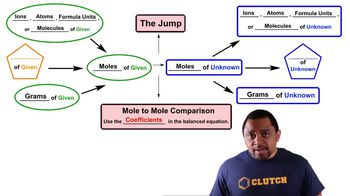
  • What is the main purpose of a thermochemical stoichiometric chart?

    It helps convert between different quantities (like moles, grams, or molecules) and the associated enthalpy change in a reaction.
  • In thermochemical equations, what key comparison is made instead of just mole-to-mole?

    A delta H to mole comparison is made, relating enthalpy change to the amount of substance.
  • How do you use the coefficients in a balanced thermochemical equation?

    The coefficients are used to perform mole-to-mole comparisons between reactants and products.
  • What is the 'jump' in a thermochemical stoichiometric chart?

    The 'jump' refers to moving from moles of a known substance to moles of an unknown substance using the balanced equation.
  • Why is it important to relate ΔHrxn to the moles of a compound in a reaction?

    Relating ΔHrxn to moles allows you to calculate the enthalpy change for any amount of reactant or product.
  • What types of quantities can be converted using a thermochemical stoichiometric chart?

    Quantities like moles, grams, molecules, ions, atoms, or formula units can be converted.
  • What must be present for a chemical equation to be considered thermochemical?

    The equation must include both a balanced chemical equation and the ΔHrxn value.
  • How can you determine the enthalpy change for an unknown component in a reaction?

    By using the coefficients from the balanced equation to relate moles of known and unknown substances to ΔHrxn.
  • What is the relationship between stoichiometry and thermochemical equations?

    Thermochemical equations combine stoichiometry with thermodynamics by including energy changes in mole relationships.
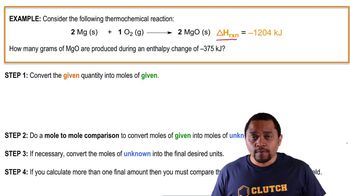
  • What is the first step when using a thermochemical stoichiometric chart?

    The first step is to identify the given quantity, such as ΔH or moles, for a compound in the reaction.
  • After finding moles of the unknown, what can you convert to next in a thermochemical equation?

    You can convert to grams, molecules, ions, or a new ΔH for the unknown.
  • Why is understanding thermochemical equations important?

    It is essential for predicting the energy changes that accompany chemical processes.
  • What is the key difference between regular stoichiometry and thermochemical equations?

    Thermochemical equations focus on the relationship between enthalpy change and the amount of substance, not just mole ratios.