For the freezing of water: H2O(l) → H2O(s), what are the signs of ΔH and ΔS?
ΔH is negative (exothermic, heat released), and ΔS is negative (entropy decreases as liquid becomes solid).
Which one of the following reactions would produce the largest amount of heat per mole of hydrogen?
The reaction with the most negative ΔHrxn value per mole of H2 produces the largest amount of heat per mole of hydrogen.
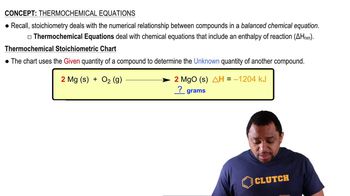
What is required for a correctly written thermochemical equation?
A correctly written thermochemical equation must be balanced and include the physical states of all reactants and products, along with the enthalpy change (ΔHrxn) for the reaction.
Which of the following statements regarding enthalpy is false?
A false statement would be: 'Enthalpy change depends on the path taken between reactants and products.' (Enthalpy is a state function and only depends on initial and final states.)
For which phase changes would q > 0?
q > 0 (heat absorbed) for melting (fusion), vaporization, and sublimation.
The ΔHrxn of formation of carbon dioxide is negative. Which statement is true?
The formation of CO2 from its elements is exothermic; heat is released during the reaction.
What is the enthalpy of vaporization if k = 3.2 × 10⁻³ at 0°C and 8.1 × 10⁻³ at 50°C?
To find the enthalpy of vaporization, use the Clausius-Clapeyron equation relating vapor pressure (k) and temperature. ΔHvap can be calculated from the slope of ln(k) vs. 1/T.
What is the difference between the heat (q) of a reaction and the reaction enthalpy (ΔHrxn)?
q is the heat exchanged under specific conditions, while ΔHrxn is the enthalpy change at constant pressure, representing the heat of reaction under standard conditions.
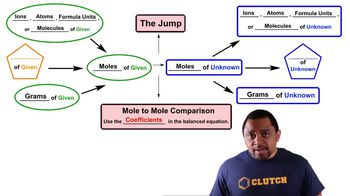
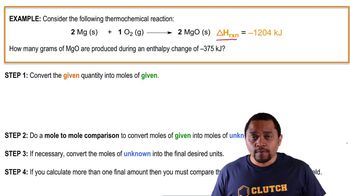
What is the change in enthalpy when gas is completely reacted according to the following reaction?
The change in enthalpy is equal to the ΔHrxn value given for the complete reaction of the specified amount of gas, based on the balanced thermochemical equation.
Is the dissolution reaction of urea enthalpically favored?
If ΔH for the dissolution of urea is negative, it is enthalpically favored; if positive, it is not. Typically, urea dissolution is endothermic (ΔH > 0), so it is not enthalpically favored.
Which of the following is a correctly written thermochemical equation?
A correctly written thermochemical equation is balanced, includes physical states, and lists ΔHrxn. Example: 2H2(g) + O2(g) → 2H2O(l); ΔHrxn = -571.6 kJ.
What is the enthalpy of the overall chemical equation NO(g) + O(g) → NO2(g)?
The enthalpy of the reaction is the ΔHrxn value associated with the formation of NO2 from NO and O, as given in the thermochemical equation.
Which equation is a correctly written thermochemical equation?
A correctly written thermochemical equation is balanced, includes physical states, and provides ΔHrxn. Example: C(s) + O2(g) → CO2(g); ΔHrxn = -393.5 kJ.
Which of the following reactions would have an enthalpy change equal to ΔHf°? Select all that apply.
Reactions that form 1 mole of a compound from its elements in their standard states have ΔH equal to ΔHf°. Select all such formation reactions.
Choose the thermochemical equation that illustrates ΔHf° for Li2SO4.
The equation: 2Li(s) + S(s) + 2O2(g) → Li2SO4(s); ΔHrxn = ΔHf°(Li2SO4) illustrates the standard enthalpy of formation for Li2SO4.