Skip to main content
Genetics
My Course
Learn
Exam Prep
AI Tutor
Study Guides
Textbook Solutions
Flashcards
Explore
Try the app
My Course
Learn
Exam Prep
AI Tutor
Study Guides
Textbook Solutions
Flashcards
Explore
Try the app
Back
Induced Mutations definitions
You can tap to flip the card.
Induced Mutation
You can tap to flip the card.
👆
Induced Mutation
A DNA sequence change caused by exposure to external agents like chemicals or radiation, often generated in laboratory settings.
Track progress
Control buttons has been changed to "navigation" mode.
1/14
Related flashcards
Related practice
Recommended videos
Induced Mutations quiz #1
Induced Mutations
13 Terms
Induced Mutations
17. Mutation, Repair, and Recombination
7 problems
Topic
Kylia
DNA Repair
17. Mutation, Repair, and Recombination
7 problems
Topic
Kylia
17. Mutation, Repair, and Recombination
4 topics
10 problems
Chapter
Nicole
Guided course
04:29
Induced Mutations
1542
views
19
rank
Terms in this set (14)
Hide definitions
Induced Mutation
A DNA sequence change caused by exposure to external agents like chemicals or radiation, often generated in laboratory settings.
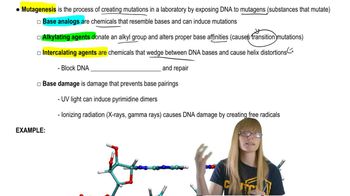
Mutagenesis
The deliberate process of creating genetic alterations, typically using physical or chemical agents in experimental environments.
Base Analog
A chemical resembling a DNA base that, when incorporated, forms incorrect base pairs, leading to genetic errors.
Alkylating Agent
A compound that attaches alkyl groups to DNA bases, disrupting normal pairing and frequently causing base transitions.
Intercalating Agent
A molecule that inserts between DNA bases, distorting the helix and impeding replication or repair, sometimes causing cell death.
Helix Distortion
A structural change in DNA caused by foreign molecules wedging between bases, creating obstacles for replication enzymes.
Base Damage
A modification or injury to DNA bases, often preventing correct pairing and resulting from UV or ionizing radiation.
Thymine Dimer
A covalent linkage between adjacent pyrimidine bases, typically induced by UV light, that disrupts DNA structure.
Ionizing Radiation
High-energy waves or particles, such as gamma or X-rays, that generate free radicals and cause severe DNA damage.
Free Radical
A highly reactive molecule produced by radiation that steals electrons from other molecules, leading to cellular and DNA harm.
AMES Test
A laboratory assay using bacteria to evaluate whether a substance can induce genetic mutations.
Rat Liver Extract
A preparation containing metabolic enzymes used to simulate human digestion of chemicals during mutagenicity testing.
Transition
A specific type of base substitution in DNA where a purine replaces another purine or a pyrimidine replaces another pyrimidine.
Polymerase
An enzyme responsible for synthesizing new DNA or RNA strands, which can be blocked by DNA structural abnormalities.
 BackBack

 04:29
04:29