Why is DNA replication said to be semiconservative?
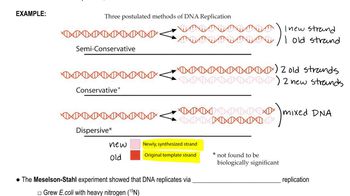
Because each new DNA molecule contains one strand from the original DNA and one newly synthesized strand.
What is the significance of the double helix structure in DNA replication?
The double helix structure allows each strand to serve as a template for the synthesis of a new complementary strand.
What is the main conclusion of Meselson and Stahl's experiment?
The main conclusion is that DNA replicates via the semiconservative model.
What would be observed if DNA replicated conservatively?
There would be separate bands for heavy and light DNA after one round of replication.
What would be observed if DNA replicated dispersively?
There would be only mixed-weight DNA bands after every round of replication.
What is the function of each DNA strand during replication?
Each DNA strand serves as a template for the synthesis of a new complementary strand.
What is the result of DNA replication in terms of genetic information?
DNA replication produces two identical DNA molecules, each with one parental and one new strand, preserving genetic information.
Why is semiconservative replication important for genetic fidelity?
It ensures that each daughter cell receives an exact copy of the genetic material.
What is the role of complementary base pairing in DNA replication?
Complementary base pairing ensures accurate synthesis of new DNA strands using the parental strands as templates.
How does the semiconservative model differ from the conservative model?
In the semiconservative model, each new DNA molecule has one old and one new strand; in the conservative model, one molecule is entirely old and the other entirely new.
How does the semiconservative model differ from the dispersive model?
In the semiconservative model, each DNA molecule has one old and one new strand; in the dispersive model, both strands are mixtures of old and new DNA segments.
What is the significance of nitrogen isotope labeling in DNA replication studies?
Nitrogen isotope labeling allows scientists to distinguish between old and new DNA strands, helping to determine the mode of replication.
What is the outcome of DNA replication in terms of strand composition?
Each new DNA molecule contains one parental strand and one newly synthesized strand.
What is the key experimental evidence supporting semiconservative replication?
The appearance of mixed and light DNA bands after replication cycles in Meselson and Stahl's experiment supports semiconservative replication.
What is the process by which DNA is copied before cell division?
DNA is copied by semiconservative replication before cell division.
What is the importance of the Meselson and Stahl experiment in genetics?
It provided definitive evidence that DNA replication is semiconservative.
 Back
Back
 14:31
14:31